The short answer
The 14 allergens UK and EU food labels must declare are: cereals containing gluten, crustaceans, eggs, fish, peanuts, soybeans, milk, tree nuts, celery, mustard, sesame seeds, sulphur dioxide and sulphites, lupin and molluscs (sulphites above 10 mg/kg or 10 mg/litre). Emphasize them, usually in bold, every time they appear in the ingredient list.
The list is Annex II of Regulation (EU) No 1169/2011. It applies in the EU and Northern Ireland, and Great Britain kept it when it left the EU. The same 14 apply to food you sell loose or prepare on site, where the information may be given in other ways.
The 14 allergens and what each includes
| Allergen | What it covers (Annex II) | In an ingredient list |
|---|---|---|
| 1. Cereals containing gluten | Cereals containing gluten, namely: wheat (such as spelt and khorasan wheat), rye, barley, oats or their hybridised strains, and products thereof Except: wheat based glucose syrups including dextrose; wheat based maltodextrins; glucose syrups based on barley; cereals used for making alcoholic distillates including ethyl alcohol of agricultural origin. | wheat flour, spelt (wheat), barley malt extract, oats |
| 2. Crustaceans | Crustaceans and products thereof | prawns (crustaceans) |
| 3. Eggs | Eggs and products thereof | free-range egg yolk |
| 4. Fish | Fish and products thereof Except: fish gelatine used as carrier for vitamin or carotenoid preparations; fish gelatine or Isinglass used as fining agent in beer and wine. | anchovies (fish) |
| 5. Peanuts | Peanuts and products thereof | roasted peanuts |
| 6. Soybeans | Soybeans and products thereof Except: fully refined soybean oil and fat; natural mixed tocopherols (E306), natural D-alpha tocopherol, natural D-alpha tocopherol acetate, and natural D-alpha tocopherol succinate from soybean sources; vegetable oils derived phytosterols and phytosterol esters from soybean sources; plant stanol ester produced from vegetable oil sterols from soybean sources. | tofu (soya) |
| 7. Milk | Milk and products thereof (including lactose) Except: whey used for making alcoholic distillates including ethyl alcohol of agricultural origin; lactitol. | whey (milk), skimmed milk powder |
| 8. Nuts | Nuts, namely: almonds (Amygdalus communis L.), hazelnuts (Corylus avellana), walnuts (Juglans regia), cashews (Anacardium occidentale), pecan nuts (Carya illinoinensis (Wangenh.) K. Koch), Brazil nuts (Bertholletia excelsa), pistachio nuts (Pistacia vera), macadamia or Queensland nuts (Macadamia ternifolia), and products thereof Except: nuts used for making alcoholic distillates including ethyl alcohol of agricultural origin. | flavouring (almond), hazelnuts |
| 9. Celery | Celery and products thereof | celery seed |
| 10. Mustard | Mustard and products thereof | mustard flour |
| 11. Sesame seeds | Sesame seeds and products thereof | tahini (sesame) |
| 12. Sulphur dioxide and sulphites | Sulphur dioxide and sulphites Only at concentrations of more than 10 mg/kg or 10 mg/litre in terms of the total SO2, calculated for products as proposed ready for consumption or as reconstituted according to the manufacturer's instructions. | preservative (sodium metabisulphite) |
| 13. Lupin | Lupin and products thereof | lupin flour |
| 14. Molluscs | Molluscs and products thereof | mussels (molluscs) |
Two lists trip people up. Cereals are named by the grain (wheat, rye, barley, oats), and spelt or khorasan must say they are wheat: “spelt (wheat)”. Tree nuts are only the eight in the table; chestnuts, pine nuts and coconut aren’t on the UK or EU list, so they aren’t emphasized as nuts. Mustard is the one difference between the two: since 1 April 2025 the EU no longer requires it to be declared for certain additives made with behenic acid from mustard seed, while Great Britain still does.
How to emphasize allergens in an ingredient list
- Make them stand out from the rest of the list: bold is usual; a contrasting colour, underlining or capitals also work.
- Every time the allergen appears, including inside compound ingredients, not just the first time.
- Refer clearly to the allergen when the ingredient name doesn’t: “whey (milk)”, “tofu (soya)”. Emphasize only the allergen word: “skimmed milk powder”.
- No separate “Contains” box repeating the allergens when there is an ingredient list. An explanation is allowed: “Allergy advice: for allergens, see ingredients in bold”. Icons may be used only alongside the words.
This is the ingredient list the maker writes for our chocolate chip cookies sample for Great Britain:
Great Britain · cookiesIngredients: Semisweet chocolate chips (Sugar, Chocolate, Cocoa butter, Milkfat, Soy lecithin, Natural flavor), Enriched wheat flour (Wheat flour, Niacin, Reduced iron, Thiamin mononitrate, Riboflavin, Folic acid), Butter (Cream (milk), Salt), Brown sugar, Sugar, Eggs, Vanilla extract, Salt, Baking soda.
And for the all-butter shortbread, where the allergens sit inside compound ingredients:
Great Britain · shortbreadIngredients: Wheat flour (Wheat flour, Calcium carbonate, Iron, Niacin, Thiamin), Butter (31%) (Cream (milk), Salt), Sugar, Rice flour.
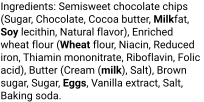
The cookies’ ingredient list as the maker draws it for the pack, with the allergens in bold.
The maker suggests allergens from ingredient names, but you confirm each one: it never decides for you. Our ingredient label maker writes the list for each market.
Prepacked, PPDS and loose food (Natasha's Law)
UK rules sort food into three groups, and the allergen information each needs is different:
| Type of food | Example | What the label needs |
|---|---|---|
| Prepacked | Packed before sale, often elsewhere: a box of biscuits, a jar of sauce | Full labeling, including the ingredient list with the 14 allergens emphasized and the nutrition declaration |
| Prepacked for direct sale (PPDS) | Packed on the same premises before the customer orders it: sandwiches in a café fridge, salads, baked goods packed in a bakery | The name of the food and a full ingredient list with the 14 allergens emphasized; no nutrition declaration |
| Loose (non-prepacked) | Sold unpackaged, or packed at the customer’s request: a deli counter, a restaurant meal | No label, but allergen information must be available to the customer |
The PPDS rule is known as Natasha’s Law, after Natasha Ednan-Laperouse, who died in 2016 after an allergic reaction to sesame baked into a baguette whose packaging didn’t list it. It has applied since 1 October 2021. A PPDS label follows the same emphasis rules as a prepacked one. The maker doesn’t have a separate PPDS label yet: its Great Britain ingredient list already emphasizes the 14 allergens, so put the name of the food above it. For which foods need a nutrition panel at all, see PPDS and other exemptions.
Foods without an ingredient list
Some foods don’t need an ingredient list: drinks with more than 1.2% alcohol, or packs whose largest surface is under 10 cm², for example. They must still declare allergens, with the word “Contains” followed by the allergen’s name: “Contains: sulphites”. This is the only place a “Contains” statement belongs on a UK or EU label.
'May contain' statements
“May contain” (precautionary) labeling is voluntary. Use it only when a risk assessment finds a real risk of cross-contact that you can’t avoid, not as a general disclaimer, and never instead of good allergen management. Name the allergen: “May contain peanuts”, because “may contain nuts” doesn’t cover peanuts. Don’t combine it with a “free from” claim for the same allergen. The maker never adds a “may contain” statement on its own; you add one, with your own risk-assessment note.
Selling outside the UK and EU?
Other markets have their own lists and their own way of declaring them. The same cookies, as the maker writes them:
| Market | Allergens declared | How | The cookies’ statement |
|---|---|---|---|
| United StatesNine major food allergens | Major food allergens: milk, egg, fish, crustacean shellfish, wheat, peanuts, soy, sesame. Tree nuts (FDA Table 1): almonds, Brazil nuts, cashews, hazelnuts, macadamia nuts, pecans, pine nuts, pistachios, walnuts. | A “Contains” statement after the ingredient list (or the source in brackets in the list). Tree nuts, fish and crustacean shellfish are named by type. | Contains: Milk, Soy, Wheat, Egg. |
| CanadaPriority food allergens, gluten sources and added sulphites | Priority food allergens: almonds, Brazil nuts, cashews, hazelnuts, macadamia nuts, pecans, pine nuts, pistachios, walnuts, peanuts, sesame, wheat, triticale, egg, milk, soy, crustacean, mollusc, fish, mustard. Gluten sources: barley, oats, rye, triticale, wheat. Added sulphites (10 ppm or more): sulphites. | In brackets in the list or in a bilingual “Contains / Contient” statement after it; gluten sources and added sulphites too. | Contains: Milk, Soy, Wheat, Egg |
| Australia and New ZealandPlain English Allergen Labelling (PEAL) | Cereals (wheat; barley, oats, rye containing gluten): wheat, barley, oats, rye. Tree nuts: almond, Brazil nut, cashew, hazelnut, macadamia, pecan, pine nut, pistachio, walnut. Other required names: crustacean, egg, fish, lupin, milk, mollusc, peanut, sesame, soy, sulphites. | Required names in bold in the ingredient list, plus a bold “Contains” summary statement. | Contains milk, soy, wheat, gluten, egg |
One product, each market’s allergen text