The short answer
Since 1 January 2026, most prepackaged foods sold in Canada that meet or exceed Health Canada’s thresholds for saturated fat, sugars or sodium must show a black-and-white magnifying-glass symbol saying “High in / Élevé en” and the nutrient or nutrients, unless the food is exempt. The usual threshold is 15% of the Daily Value per reference amount (10% for small reference amounts, 30% for main dishes).
What the symbol looks like
The symbol is a fixed piece of artwork: a magnifying glass, the words “High in / Élevé en”, one bar for each nutrient (“Sat fat / Gras sat.”, “Sugars / Sucres”, “Sodium”) and the attribution “Health Canada / Santé Canada”. It comes in versions for one, two or all three nutrients, horizontal or vertical, bilingual (English first or French first) or as separate English and French symbols. Packs bigger than 30 cm² always show three bar positions, with blank bars for the nutrients that aren’t high.
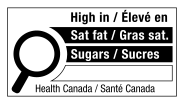
The symbol our chocolate chip cookies sample needs, placed by the maker from Health Canada’s official artwork, unaltered. Symbol: Health Canada, Compendium of Nutrition Symbol Formats.
You may not redraw it, recolour it, add to it or use anything that looks like it. The maker never draws its own version: it embeds the official files from Health Canada’s Compendium of Nutrition Symbol Formats, at the official size for your pack.
The thresholds
The test compares three nutrients with their Daily Values: saturated fat on its own against 20 g (the Daily Value for saturated plus trans fat), sugars against 100 g and sodium against 2,300 mg. The amount compared is per reference amount or per serving of stated size, whichever is greater (for foods whose reference amount is for the prepared food, the serving). A food needs the symbol for each nutrient at or above its threshold:
| Food | Threshold | Saturated fat | Sugars | Sodium |
|---|---|---|---|---|
| Small reference amountReference amount of 30 g or 30 mL or less | 10% DV | 2 g | 10 g | 230 mg |
| Most foodsReference amount over 30 g or 30 mL | 15% DV | 3 g | 15 g | 345 mg |
| Main dishesPrepackaged main dish with a reference amount of 200 g or more | 30% DV | 6 g | 30 g | 690 mg |
Amounts are the thresholds at the general-population Daily Values (FDR B.01.350 and its table; Table of Daily Values). Foods for children aged 1 to 4 use other values, which the maker doesn’t apply.
Health Canada prescribes no rounding for this test and suggests using the same rounding as the Nutrition Facts table. The maker checks both the unrounded and the rounded %DV, and when they fall on different sides of the threshold it says “Needs review” instead of guessing.
Foods that are exempt, and foods that can't show it
Never shown (prohibited). These foods must not carry the symbol:
- A food intended solely for infants 6 months to less than 1 year old.
- A human milk fortifier.
- A human milk substitute, or a food represented as containing one.
- A formulated liquid diet.
- A meal replacement.
- A nutritional supplement.
- A food represented for protein-restricted diets.
- A food represented for a low (amino acid) diet.
- A food represented for very low energy diets.
Fully exempt. No symbol, whatever the nutrients:
- A shipping container not sold to consumers as one unit.
- An individual portion served by a restaurant or other business with meals or snacks.
- A ready-to-serve multiple-serving product sold only to businesses or institutions.
- Sold only as an ingredient for manufacturing or food preparation by a business.
- Milk or cream in a refillable glass container.
- A sweetening agent sold as such (sugar, honey, maple syrup, agave, molasses …).
- Table salt or a seasoning salt with “salt” in its common name.
- A fat or oil sold as such (butter, ghee, margarine, vegetable or fish oil).
- An individual military ration.
- Fresh single-ingredient coconut (not frozen, dried or canned).
- Packages with less than 15 cm² of available display surface.
Exempt while the food is exempt from the Nutrition Facts table, for example:
- Raw single-ingredient meat or poultry (not ground).
- Raw single-ingredient fish or seafood.
- Sold only in the store where it is prepared and processed.
- Sold only by the maker at a road-side stand, craft show, flea market, fair, farmers’ market or sugar bush.
- An individual serving sold for immediate consumption and not processed to extend its shelf life.
- Sold only where it is packaged, labelled with a sticker, with less than 200 cm² of available display surface.
Exempt for a nutrient, because of where it comes from. A food doesn’t need the symbol for saturated fat or sodium that comes only from whole fruit or vegetables, plain milk, whole eggs, fish, or nuts and seeds whose fat is less than 30% saturated, or for sugars that come only from fruit, vegetables, milk, grains, legumes, nuts or seeds, with nothing added. Cheese, yogurt, kefir and buttermilk with at least 5% of the Daily Value for calcium have their own exemptions. Adding a vitamin or mineral, or making a nutrition or health claim, can cancel the table-linked exemptions; see nutrition labelling exemptions.
Where it goes and how big
The symbol goes on the principal display panel: in the upper half when the panel is at least as tall as it is wide, otherwise in the right half. It needs a clear space around it with no text or graphics, it follows the orientation of most of the panel’s text, and it never goes inside the Nutrition Facts table. On cylinders the clear space must stay at least 10% of the panel width from its edge. The vertical version must be used when the panel is 450 cm² or smaller and the horizontal symbol is wider than the panel.
Its size is fixed by the area of the principal display surface. The bilingual versions (English first) are:
| Principal display surface | Horizontal | Vertical | Clear space |
|---|---|---|---|
| > 600 cm² | 62.9 × 33 mm | Not used at this size | 2.7 mm |
| > 450 to ≤ 600 cm² | 54 × 28.3 mm | Not used at this size | 2.3 mm |
| > 250 to ≤ 450 cm² | 45 × 23.6 mm | 21.7 × 41 mm | 1.9 mm |
| > 100 to ≤ 250 cm² | 36 × 18.9 mm | 17.5 × 33.1 mm | 1.5 mm |
| > 30 to ≤ 100 cm² | 28 × 14.2 mm | 13.7 × 26 mm | 1.1 mm |
| ≤ 30 cm² | 28 × 14.2 mm / 25 × 12 mm / 25 × 8.5 mm | 13.7 × 26 mm / 13.7 × 20.5 mm / 13.7 × 15 mm | 1.1 mm |
Sizes from Health Canada’s Directory of Nutrition Symbol Specifications, as drawn in its Compendium. Under 30 cm² the size also depends on how many nutrients the symbol shows (one, two or three bars). You may scale the symbol up in proportion, never down.
Worked examples
Here is what the maker’s check says for four of our samples, using each product’s values, serving and reference amount:
| Product | Compared | Saturated fat · sugars · sodium (% DV) | Result |
|---|---|---|---|
| Chocolate Chip Cookies | per reference amount (30 g), which is at least the serving of stated size (30 g) | 23.55% ✓ · 12.97% ✓ · 5.67% | Symbol requiredhigh in saturated fat and sugars (threshold 10% (reference amount of 30 g or less)). |
| Smoky BBQ Sauce | per reference amount (30 mL), which is at least the serving of stated size (29.57 mL) | 0.11% · 11.14% ✓ · 14.05% ✓ | Symbol requiredhigh in sugars and sodium (threshold 10% (reference amount of 30 mL or less)). |
| Honey Almond Granola | per 55 g reference amount (interim policy for dense ready-to-eat cereals with a 1 cup serving) | 5.46% · 10.59% · 3.51% | Not requiredbelow the 15% threshold. |
| Pure Maple Syrup | — | — | Not requiredthe product is a sweetening agent sold as such (sugar, honey, maple syrup, agave, molasses …). |
✓ = at or above the threshold. Percentages are unrounded, per the basis shown.
The cookies are the clear case: a 30 g reference amount puts them in the 10% class, and both saturated fat and sugars are over it. The maker picks symbol 3.2(BH) for their pack and places it next to the bilingual table:
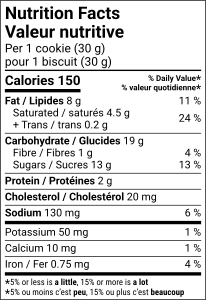
The cookies’ bilingual Nutrition Facts table and front-of-package symbol, both drawn by the maker.
Check your product
Open the Canadian workflow and enter your values, serving and food category. Add your pack’s principal display area and the maker:
- finds the reference amount and threshold class, and compares per reference amount or per serving, whichever is greater;
- asks the questions only you can answer: is it a main dish, do the sugars come only from fruit or milk, is it sold only where it’s made;
- says Symbol required (with the nutrients), Not required (with the reason), Not permitted, or Needs review when an exemption depends on facts it can’t see;
- places the official symbol at the official size in your downloads, next to the bilingual table.
About the artwork and the check