Nutrition information panel calculator
for Australia
Enter values or a recipe and get a NIP laid out as Schedule 12 of the Food Standards Code describes, with average quantities per serving and per 100 g and allergens in plain English.
NIPs per serving and per 100 g, ready to download.
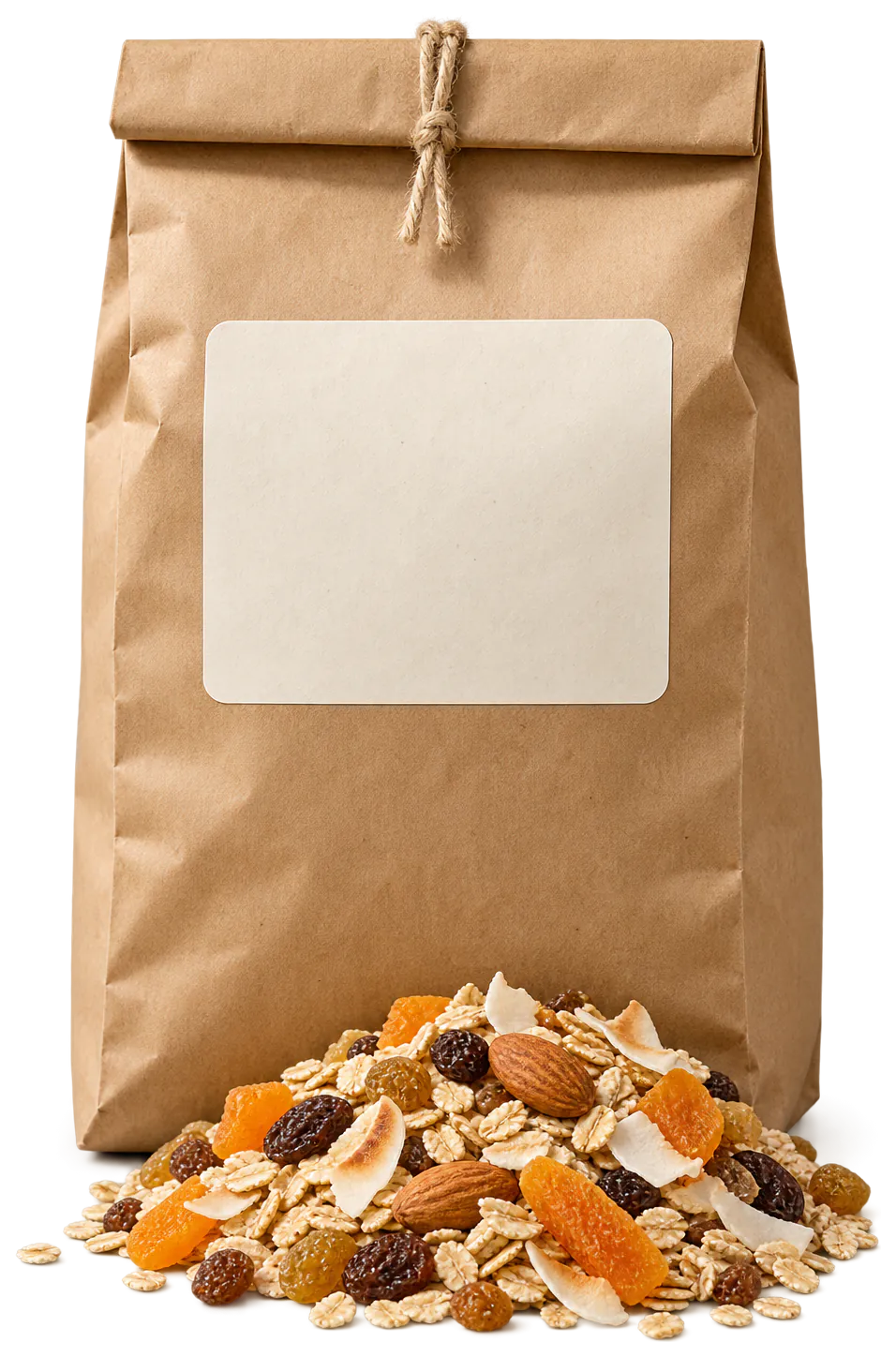
The sample’s serving is set for Australia; the maker asks you to check it for this market.
No “High in” symbol needed on the front of pack Below the 15% threshold. Saturated fat 5.08%, sugars 9.98% and sodium 0.2% of the daily value per serving.
-
Schedule 12 layout
NUTRITION INFORMATION with average quantities per serving and per 100 g, in the Code’s order.
-
3 significant figures
Rounded once, from unrounded values, with FSANZ’s convention and ties to even.
-
Energy in kilojoules
Worked out with the Schedule 11 factors. kcal and %DI when you want them.
-
Plain English allergens
Required names in bold in the ingredient list, plus the bold “Contains” summary.
How it works
-
Step 1: Choose Australia
Add New Zealand too if you sell there: the panel is the same, the origin rules are not.
-
Step 2: Add your numbers
Values per 100 g or per serving from a lab or supplier, a recipe from USDA ingredient data, or the numbers from an existing panel.
-
Step 3: Check and download
The nutrition panel calculator works out both columns. Download the NIP at its real size. No sign-up to build. Free account to download.
On this page 11 sections
- What an Australian NIP must show
- Per serving and per 100 g, side by side
- Energy and carbohydrate under Schedule 11
- Worked example: toasted muesli
- Allergens in plain English (PEAL)
- Country of origin is a separate label
- Health Star Rating
- FSANZ Nutrition Panel Calculator or this tool?
- Selling in New Zealand too?
- What we check, and what you still check
- FAQ
What an Australian NIP must show
A nutrition information panel (NIP) starts with the number of servings per package and the serving size. Then come seven rows, each as an average quantity per serving and per 100 g (or 100 mL for liquids), in the order of Schedule 12 of the Food Standards Code. The rules sit in Standard 1.2.8, and every number may have at most 3 significant figures (1.2.8—7(3)).
| Row | Unit | %DI reference |
|---|---|---|
| Energy | kJ | 8700 kJ |
| Protein | g | 50 g |
| Fat, total | g | 70 g |
| —saturated | g | 24 g |
| Carbohydrate | g | 310 g |
| —sugars | g | 90 g |
| Sodium | mg | 2300 mg |
Other rows join only when you make a claim, and a voluntary row is itself a claim (except fibre under 2 g per serving, trans fat and lactose). A claim about fibre, sugars or any carbohydrate adds a dietary fibre row; a claim about fats adds trans, polyunsaturated and monounsaturated fat; a vitamin or mineral brings its %RDI. When you add a voluntary row, the maker treats it as the claim it is: it adds the rows that claim needs and checks the conditions it knows. Here is the sample muesli’s panel, with and without the optional %DI column:
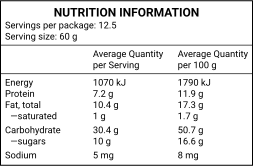
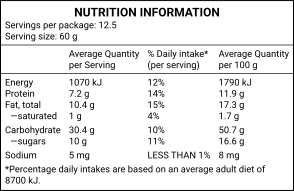
The toasted muesli NIP drawn by the engine: standard, and with the optional % daily intake column and its footnote.
Per serving and per 100 g, side by side
Unlike the US and Canada, Australia has no table of reference amounts: you choose the serving size. The panel always shows both columns, even when the serving is exactly 100 g. Enter one set of values (per 100 g, per 100 mL or per serving) and the maker works out the other column from the unrounded numbers, so rounding happens once per cell. FSANZ’s own guide shows why: 1700 kJ per 100 g with a 120 g serving prints 2030 kJ, not the 2040 you would get from the rounded figure.
Servings per package is the pack size divided by the serving: the muesli’s 750 g bag and 60 g serving give Servings per package: 12.5. For liquids the per 100 mL column needs your product’s density; the maker never assumes one.
Energy and carbohydrate under Schedule 11
Energy is always worked out from the components with the factors of Schedule 11, from unrounded grams. An energy figure you enter (a lab result, or US Calories × 4.184) stays in your record but is not printed. kcal is optional: the maker divides the unrounded kJ by 4.18 and prints it as “kJ (Cal)”.
| Component | kJ per g |
|---|---|
| Protein | 17 |
| Fat | 37 |
| Available carbohydrate | 17 |
| Unavailable carbohydrate, including dietary fibre | 8 |
| Alcohol | 29 |
Sugar alcohols and some other substances have their own factors (D-allulose 2, Erythritol 1, Glycerol 18, Isomalt 11, Lactitol 11, Maltitol 13, Mannitol 9, Organic acids 13, Polydextrose 5, Sorbitol 14, D-tagatose 11, Xylitol 14 kJ/g). The maker prints them only when it has their factor; otherwise it tells you the panel needs review.
“Carbohydrate” on a NIP means available carbohydrate: fibre and sugar alcohols are left out. From a US or Canadian total carbohydrate the maker subtracts dietary fibre and polyols, so it needs both (0 g is fine; a blank is not zero). For the muesli: total carbohydrate 61.28 g − fibre 10.6 g − polyols 0 g = 50.68 g per 100 g. Dietary fibre gets its own row on the panel when you make a claim about fibre, sugars or another carbohydrate; when it’s required and there is none, the row reads 0.
Worked example: toasted muesli
The sample toasted muesli (oats, raisins, almonds, honey, wheat bran, sunflower seeds and canola oil) has a 60 g serving. Its energy per 100 g is 17 × protein + 37 × fat + 17 × carbohydrate + 8 × fibre = 1789.84 kJ. Every printed cell below is the engine’s own output.
| Row | Per 100 g, unrounded | Printed | Per 60 g, unrounded | Printed |
|---|---|---|---|---|
| Energy | 1789.84 kJ | 1790 kJ | 1073.904 kJ | 1070 kJ |
| Protein | 11.92 g | 11.9 g | 7.152 g | 7.2 g |
| Fat, total | 17.32 g | 17.3 g | 10.392 g | 10.4 g |
| —saturated | 1.694 g | 1.7 g | 1.016 g | 1 g |
| Carbohydrate | 50.68 g | 50.7 g | 30.408 g | 30.4 g |
| —sugars | 16.64 g | 16.6 g | 9.984 g | 10 g |
| Sodium | 7.645 mg | 8 mg | 4.587 mg | 5 mg |
The rule is “no more than 3 significant figures”; FSANZ’s convention, which the maker follows, is a whole number for energy and sodium below 100, one decimal place for grams below 100, and 3 significant figures from 100, with ties going to the even figure. So 1073.9 kJ prints as 1070 kJ, and 1.0164 g of saturated fat as 1 g (the maker drops a trailing zero, as FSANZ’s calculator does; “1.0 g” is just as correct). The same rule on other numbers:
| Value | Printed | Why |
|---|---|---|
| 1234 kJ | 1230 kJ | 3 significant figures from 100 |
| 12.34 g | 12.3 g | grams below 100: 1 decimal place |
| 1145 kJ | 1140 kJ | a tie rounds to the even figure |
| 1155 kJ | 1160 kJ | a tie rounds to the even figure |
| 99.96 g | 100 g | 100.0 would be 4 figures, so 100 |
| 7.645 mg | 8 mg | sodium below 100: whole number |
A value that is not zero but would round to zero may use the Code’s own words, such as “LESS THAN 1 g”. More on rounding in all six markets: the 3 significant figures rule. Starting from a recipe instead? calculate a NIP from your recipe.
Allergens in plain English (PEAL)
Plain English Allergen Labelling (PEAL) has applied since 25 February 2024, and the period for selling stock labelled the old way ended in February 2026, so every pack on sale now needs it (Standard 1.2.3 and Schedule 9). Two things go on the label:
- each allergen’s required name in bold in the ingredient list, next to the ingredient it comes from;
- a separate summary statement that starts with “Contains”, lists only the required names, also in bold, right next to the list.
The muesli, exactly as the engine writes it:
Ingredient listIngredients: Rolled oats, Raisins, Almonds, Honey, Wheat bran, Sunflower seeds, Canola oil.
Contains gluten, almond, wheat
The 23 required names for the ingredient list are: sulphites, wheat, barley, oats, rye, almond, Brazil nut, cashew, hazelnut, macadamia, pecan, pine nut, pistachio, walnut, crustacean, egg, fish, lupin, milk, mollusc, peanut, sesame and soy. In the summary, barley, oats and rye become “gluten”, and wheat is listed as wheat and gluten, which is why the muesli reads “Contains gluten, almond, wheat”. “May contain” statements are not part of PEAL: the maker never writes one for you. More on writing the list: plain English allergen text.
Country of origin is a separate label
Origin labelling is not part of the Food Standards Code or the NIP. It comes from the Country of Origin Food Labelling Information Standard 2016, enforced by the ACCC. Most food sold in Australia is a priority food. Seven groups are non-priority: seasonings; confectionery; biscuits and snack foods; bottled water; soft drinks and sports drinks; tea and coffee; alcoholic drinks.
- A priority food grown, produced or made in Australia needs the standard mark: the kangaroo logo, a bar chart of the Australian share and the text, in a box.
- An imported priority food needs a plain statement in a clearly defined box, such as “Product of Greece”.
- A non-priority food only needs a plain statement; the mark is optional.
The engine’s origin module works these out from a few answers. Its results for four products:
| Product | Answers | Text | What goes on the pack |
|---|---|---|---|
| Toasted muesli (the sample) | Made in Australia; 89% of the ingredients by weight are Australian (the almonds are imported) | Made in Australia from at least 89% Australian ingredients | Standard mark: kangaroo logo and a bar chart filled to 80% with this text, in a box. Make it with the official free tool. |
| The same muesli in a small package | As above, package surface under 100 cm² | Made in Australia from at least 89% Australian ingredients | This statement in a clearly defined box (no logo, no bar chart). |
| Extra virgin olive oil | Imported, a product of Greece | Product of Greece | This statement in a clearly defined box (no logo, no bar chart). |
| Shortbread biscuits | Non-priority food (biscuits), made in Australia | Made in Australia | This statement; no box needed. |

The olive oil’s boxed origin statement for Australia, printed by the engine. A standard mark is never redrawn here.
We don’t draw the kangaroo logo or the bar chart. When the standard mark is needed, make it with the official free label tool on business.gov.au and place it on your pack yourself. Honest note: the origin questions are not in the maker’s form yet. Until they are, an Australian label shows “Needs review” with a reminder to add your origin statement or mark; the sample products carry their answers so you can see the result.
Health Star Rating
The Health Star Rating is a voluntary front-of-pack scheme. FSANZ is consulting on making it mandatory (Proposal P1067, second call for submissions 28 October to 23 December 2026), and it stays voluntary while that runs. The proposal would only apply after a transition period of at least three years. This tool doesn’t calculate Health Star Ratings, and a proposed rule never changes what the maker prints.
FSANZ Nutrition Panel Calculator or this tool?
FSANZ publishes its own free Nutrition Panel Calculator. Use whichever fits; they do different jobs.
| FSANZ Nutrition Panel Calculator | This nutrition panel calculator | |
|---|---|---|
| Who makes it | Food Standards Australia New Zealand, the agency that develops the Code’s standards | An independent tool, not affiliated with FSANZ |
| Where the numbers come from | Its own food composition data (the 2026 edition: about 1,500 foods from Australian datasets) | Your lab or supplier values, a recipe built from USDA FoodData Central ingredients, or numbers from a panel you already have |
| What you get | A NIP to copy into your artwork | An exact-size NIP (PDF, SVG, PNG), the ingredient list with PEAL allergens, and labels for New Zealand, the UK, the EU, Canada and the US |
| Cost | Free | Free; a free account to download |
Already have NPC results? Type them in as your values (per 100 g), choose Australia, and the maker lays out the panel at your size and adds the allergen text.
Selling in New Zealand too?
The NIP is the same in New Zealand: both countries use the joint Food Standards Code. What changes is around the panel: New Zealand only requires origin statements for a few fresh and frozen foods and cured pork, and the Australian kangaroo mark is for food sold in Australia. See the New Zealand nutrition information panel page, or how Australian labels differ from the US, UK, EU and Canada. Need an empty layout? There is a blank NIP template.
What we check, and what you still check
- Needs values. Something the label must show is missing, so the maker won’t draw that part yet. It tells you exactly what to add.
- Needs review. The label can be drawn, but something depends on facts the maker can’t see or on a rule it couldn’t confirm. It says what to check.
- Ready for the supported output. Every rule the maker applies passed for the values you gave. It is not an approval.
Built from the published rules (Food Standards Code Standard 1.2.8, Schedule 11, Schedule 12 and Standard 1.2.3). Not reviewed or approved by any regulator. Check your label before printing.
Not supported: dietary supplements, infant and young-child foods, medical foods, alcoholic drinks and other special categories. The maker routes them to a clear “not supported” message instead of drawing a label.
What the maker checked for the toasted muesli (Australia) Ready for the supported output
- Checked Carbohydrate is available carbohydrate (fiber and polyols left out). Carbohydrate 50.68 g per 100 g: carbohydrate 50.68 g = total carbohydrate 61.28 g − fibre 10.6 g − polyols 0 g.
- Checked Energy worked out with the Schedule 11 factors (kJ; kcal = kJ ÷ 4.18). energy 1789.84 kJ = 17 × protein 11.92 g + 37 × fat 17.32 g + 17 × available carbohydrate 50.68 g + 8 × dietary fibre and other unavailable carbohydrate 10.6 g (FSANZ Schedule 11); no value for unavailable carbohydrate, alcohol (counted as none)
- Checked Servings per package and serving size. 12.5 servings of 60 g (pack ÷ serving).
- Checked Per serving and per 100 g / 100 mL columns. Two columns: per serving and per 100 g (both required even when the serving is 100 g).
- Checked Energy, protein, fat, saturated fat, carbohydrate, sugars and sodium. All seven rows have values (empty is never treated as zero).
- Checked Rounding: no more than 3 significant figures. FSANZ convention: energy and sodium whole numbers below 100, grams to 1 decimal place below 100, 3 significant figures from 100, ties to even; per serving from the unrounded per-100 values.
- Checked No mandatory added sugars line. Proposal P1058 closed on 23 March 2026 without changing the panel; total sugars stay.
- Checked Panel wording. "NUTRITION INFORMATION", "Servings per package", "Serving size", "Average Quantity per Serving / per 100 g" (the FSANZ calculator wording; the Code requires the panel to say the values are averages).
- Checked No regulator logos or approval wording. FSANZ, MPI and the ACCC have no approval logo; the label carries none.
- Checked Panel layout. Schedule 12 structure: outer border, centred heading, servings lines, full-width rules around the column headings, sub-rows indented with a dash. House sizes: heading 9 pt bold, body 7 pt.
- Checked Allergens: required names in bold in the ingredients, and a bold "Contains" summary next to them. Contains gluten, almond, wheat
- You check Supplier name and business address in Australia or New Zealand. Print the name and street address of a supplier (maker, packer or importer) in Australia or New Zealand. An Australian address is accepted on New Zealand labels and the other way round.
- You check Country of origin (Australia). "Made in Australia from at least 89% Australian ingredients". Standard mark with the kangaroo logo and a bar chart (80% to 89%): make it with the official tool.
- You check Net quantity on the front of the pack. Not part of the panel: print the weight near the product name on the principal display panel, every character at least 2.0 mm up to 120 mm, 2.5 mm up to 230 mm, 3.3 mm up to 360 mm, 4.8 mm over 360 mm (by the pack’s largest dimension), at least 2 mm from the edges and other print.
- You check Kangaroo logo and bar chart. Make the standard mark with the official free tool (https://business.gov.au/products-and-services/product-labelling/country-of-origin-labelling-for-food/about-country-of-origin-labelling-for-food); we don’t redraw the official artwork.
What you still check
- Your values: average quantities from analysis, calculation or generally accepted data. A recipe calculation is not an analysis.
- Your serving size and the claims on your pack (each one can add rows and conditions).
- Your origin statement or standard mark: the origin questions are not in the maker’s form yet.
- Whether an exemption applies (unpackaged food, small packages, some single foods), and any claim that ends it.
- The rest of the label: name, supplier name and Australian or New Zealand address, date marking, storage, net quantity on the front of pack.