Make a recipe nutrition label
from your ingredients
Add your ingredients by weight, set the finished batch weight and the serving, and get the nutrition panel for your market with each ingredient's data source shown.
Ingredients and weights in, a nutrition label out.
No “High in” symbol needed on the front of pack Below the 15% threshold. Saturated fat 5.46%, sugars 10.59% and sodium 3.51% of the daily value per reference amount.
-
USDA ingredient data
8,200 generic foods from USDA FoodData Central, with the data version saved in your recipe.
-
Grams or cups
Weigh in grams, kg, oz or lb, or use the ingredient’s own household measures from USDA.
-
Your supplier’s values
Add an ingredient from its specification sheet when the generic data isn’t right.
-
Each market’s panel
One recipe gives the US, UK, EU, Canadian and Australian and New Zealand panels.
How it works
Ingredients and weights in, a nutrition label out, with each ingredient’s data source shown.
-
Step 1: Add your ingredients
Search USDA FoodData Central or add your own supplier ingredient, and enter each amount as weighed.
-
Step 2: Weigh the finished batch
Enter what the batch weighs after cooking or baking, and your serving size.
-
Step 3: Check and download
See every nutrient, what is missing and why, then the label for each market. A free account saves the product when you download.
How the recipe calculation works
The maker does the same arithmetic you would do by hand, without rounding anything until the very end:
- For each ingredient: grams × its nutrient value per 100 g ÷ 100.
- Add the lines up: the nutrients in the whole batch.
- Divide by the finished batch weight and multiply by 100: per 100 g of the finished food.
- Multiply by the serving and divide by 100: per serving.
- Round once, with the rules of each market you sell in.
per 100 g = Σ (grams × value per 100 g ÷ 100) ÷ finished weight × 100
For example, a 1,000 g batch of our granola mix holds 4,401 kcal. It bakes down to 800 g, so the finished granola has 4,401 ÷ 800 × 100 = 550.1 kcal per 100 g. Each step keeps every decimal: rounding early and then scaling a rounded value is how labels drift away from the true value.
Each recipe line keeps the ingredient values it was calculated with, and the recipe keeps the data version, so an update of the ingredient data doesn’t silently change a label you have already made.
Ingredient data, and when to replace it
The maker ships USDA FoodData Central data: SR Legacy (April 2018) and Foundation Foods (October 2026). It is public domain
(CC0), and the data version in use now is fdc-sr2018-fd2026-10-45d04d4eeb. These are generic foods (“Nuts, almonds”, “Honey”), not branded products.
- Use your supplier’s values for branded or unusual ingredients: a chocolate chip, a spice blend, a flavored syrup. Add them as a custom ingredient, per 100 g or per serving, with their allergens and their own ingredient list.
- Household measures use that ingredient’s own weight. A cup is a volume, and a cup of one food weighs very differently from a cup of another. These are USDA’s weights for one cup of the granola’s ingredients:
| Ingredient | USDA measure | Weight |
|---|---|---|
| Whole grain rolled oats | 1 cup | 81 g |
| Almonds | 1 cup, whole | 143 g |
| Honey | 1 cup | 339 g |
| Brown sugar | 1 cup packed | 220 g |
| Canola oil | 1 cup | 218 g |
A cup of honey weighs about 4.2 times a cup of oats. The maker converts a cup or a spoon with the weight USDA gives for that ingredient and that measure, never with one density for everything. Grams are still the most accurate.
Weigh the finished batch
Recipe yield is the weight of the finished food. Baking, roasting and simmering drive off water; the nutrients stay behind, so every gram of the finished food carries more of them than a gram of the raw mix.
The same 1,000 g batch, calculated by the maker with and without its finished weight:
| Per 100 g | Finished weight 800 g | No finished weight (1,000 g) |
|---|---|---|
| Energy | 550.1 kcal | 440.1 kcal |
| Fat | 24.7 g | 19.8 g |
| Sugars | 22.2 g | 17.8 g |
| Sodium | 152 mg | 122 mg |
Leave the finished weight out and the maker divides by the weight of the ingredients, as if nothing was lost: every value comes out 20% too low. Weigh the whole batch once it has cooled, before you portion it.
Worked example: honey almond granola
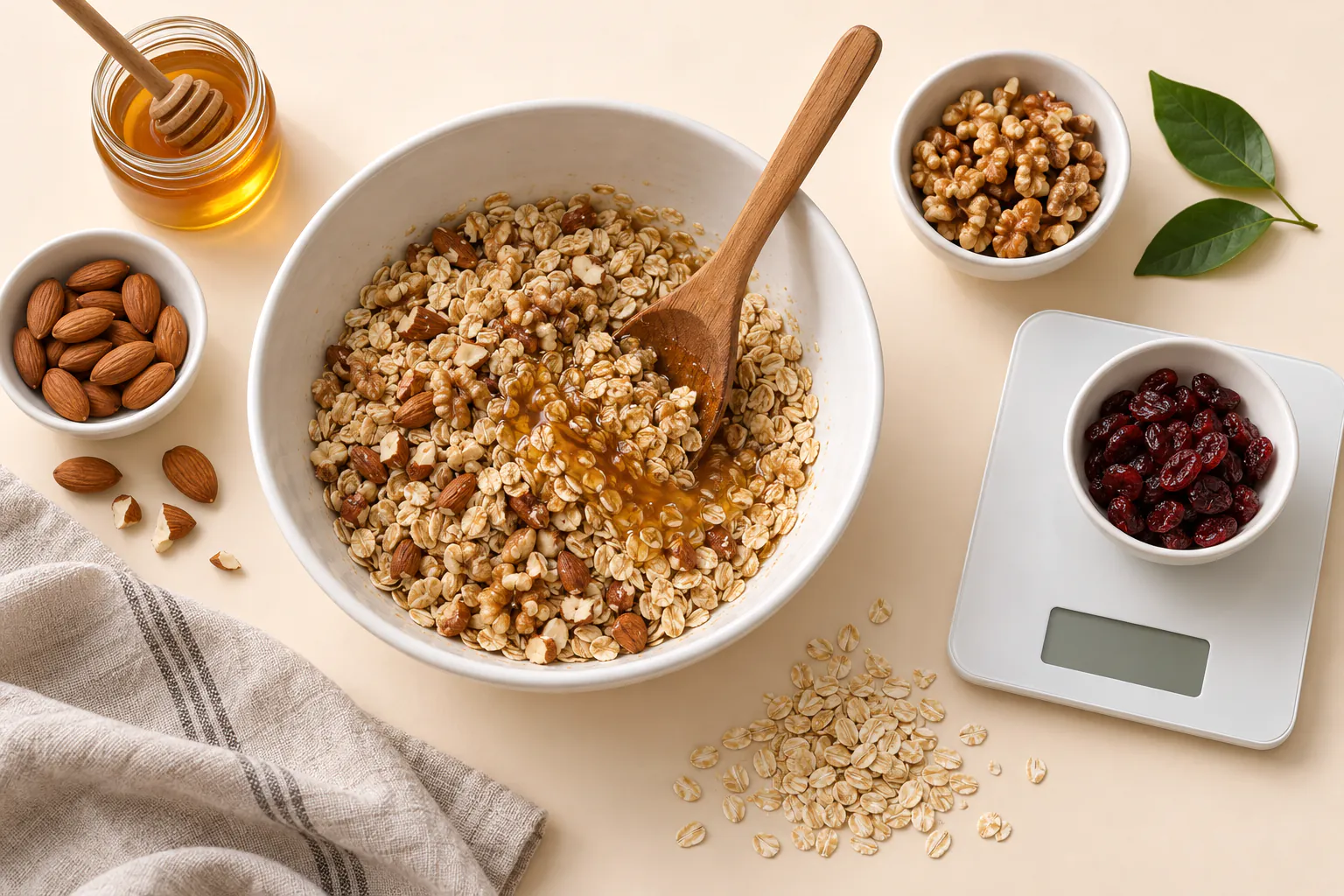
Our sample honey almond granola: 899 g of ingredients baked to 827 g (92% yield), served as 1 cup (60 g). Each line is the ingredient’s USDA value per 100 g × its weight ÷ 100; energy in kcal, sodium in mg, the rest in grams.
| Ingredient | Grams | Energy | Fat | Sat. fat | Carbs | Sugars | Added sugars | Protein | Sodium |
|---|---|---|---|---|---|---|---|---|---|
| Whole grain rolled oats | 500 | 1,895 | 32.6 | 5.6 | 338.5 | 5 | 0 | 65.8 | 30 |
| Almonds | 150 | 869 | 74.9 | 5.7 | 32.3 | 6.5 | 0 | 31.7 | 2 |
| Honey | 120 | 365 | 0 | 0 | 98.9 | 98.5 | 98.5 | 0.4 | 5 |
| Brown sugar | 50 | 190 | 0 | 0 | 49 | 48.5 | 48.5 | 0.1 | 14 |
| Canola oil | 70 | 619 | 70 | 5.2 | 0 | 0 | 0 | 0 | 0 |
| Sea salt | 3 | 0 | 0 | 0 | 0 | 0 | 0 | 0 | 1,163 |
| Vanilla extract | 6 | 17 | 0 | 0 | 0.8 | 0.8 | 0.8 | 0 | 1 |
| Whole batch | 899 | 3,954 | 177.5 | 16.4 | 519.5 | 159.3 | 147.8 | 97.9 | 1,214 |
| Per 100 g (÷ 827 g baked) | 100 | 478 | 21.5 | 2 | 62.8 | 19.3 | 17.9 | 11.8 | 147 |
| Per serving (60 g) | 60 | 287 | 12.9 | 1.2 | 37.7 | 11.6 | 10.7 | 7.1 | 88 |
Added sugars: the sugars of the honey, brown sugar and vanilla extract count in full; oats, almonds and oil add none. The maker never works added sugars out from total sugars: sweeteners count in full, single whole foods count as none, and for other processed ingredients you enter the value.
The same recipe, drawn by the maker as a US Nutrition Facts panel and a UK nutrition table:
What a recipe calculation can’t know
A calculation assumes the nutrients in the ingredients end up in the food. That isn’t true for every process:
- Frying: the food takes up an unknown amount of the frying oil.
- Fermentation: yeasts and bacteria use up sugars and make other compounds.
- Long cooking or draining: vitamins break down, and fat or salt can be poured away with the liquid.
- Supplier variation: your ingredients may differ from the generic data, from batch to batch and from one supplier to another.
Note such a process in the recipe and the maker marks the label Needs review instead of Ready. When the data has no value for a nutrient, the maker shows it as missing, never as 0. In our granola, USDA’s oats record has no trans fat value. Without your confirmation the maker reports:
“Trans fat: no data for Whole grain rolled oats. Add a value, or confirm the ingredient has none.”
You either add the value from your supplier, or confirm that the ingredient has none (plain oats have no trans fat); the confirmation is listed in “What we checked”. Get a lab analysis for fried or fermented foods, long-cooked products, nutrition or health claims, and when a buyer asks for one.
Allergens from your ingredients
Your recipe also gives the ingredient list, heaviest first. The maker suggests allergens from each ingredient’s name, and you confirm each one: a suggestion never reaches the label on its own. The ingredient list and allergen statement for each market are explained on the ingredient list and allergens page.
What we check, and what you still check
For each market, the maker checks that the values it needs are there, applies that market’s nutrients, order, rounding and reference values, and checks the format fits and the type stays above the legal minimum. It shows each market as Needs values, Needs review or Ready for the supported output, with what it checked and what is out of scope.
Calculated values
Labels are built from the published rules (21 CFR 101.9 and 101.12 in the US; the Food and Drug Regulations in Canada; Regulation (EU) No 1169/2011 and its GB version; Food Standards Code Standard 1.2.8 and Schedules 11 and 12 in Australia and New Zealand). They are not reviewed or approved by any regulator. Check your label before printing. Supplements, infant foods, medical foods, alcohol and other special categories are not supported.
Ingredient data: USDA FoodData Central, SR Legacy (April 2018) and Foundation Foods (October 2026), public domain (CC0); data version fdc-sr2018-fd2026-10-45d04d4eeb. Rules: 21 CFR 101.9, Regulation (EU) No 1169/2011, Food Standards Code.