The short answer
Most packaged foods need a nutrition label. Each market has exemptions, usually for small businesses or small volumes, for food made and sold on the spot or unpackaged, for a list of simple foods (plain coffee, tea, spices, single fresh ingredients) and for very small packs. A nutrition or health claim cancels almost every exemption, and exempt foods usually still need an ingredient list and allergen information.
The details differ by market. This guide sets out the main exemptions in each one and what cancels them. If your product sits near a line, ask a food-labeling specialist or your local food authority before you rely on an exemption.
United States
The FDA’s exemptions are in 21 CFR 101.9(j). The ones small food businesses use most:
- Small businesses: a business with annual gross sales to consumers of no more than $500,000, or food sales to consumers of no more than $50,000 (21 CFR 101.9(j)(1)(i)-(ii)).
- Low-volume products: fewer than 100 full-time-equivalent employees and fewer than 100,000 units of the product sold in the US in a year. You file a notice with the FDA before the exemption year, unless you are not an importer, have fewer than 10 employees and sell fewer than 10,000 units. If you outgrow the thresholds, you have 18 months to add the label (21 CFR 101.9(j)(18)(ii)-(iv), (j)(18)(vi)).
- Food served or sold for immediate eating in restaurants and similar places, and food sold only to them.
- Ready-to-eat food prepared mainly in the store that sells it (an in-store bakery or deli, for example) and not sold anywhere else.
- Foods with insignificant amounts of every nutrient, such as coffee beans, tea leaves, plain unsweetened instant coffee and tea, flavor extracts and food colors.
- Raw fruits, vegetables and fish, which have a voluntary point-of-purchase program instead.
- Bulk food shipped for further manufacturing, not sold to consumers in that form.
- Packages with less than 12 square inches available for labeling: no panel, but the label must give an address or phone number where consumers can get the nutrition information.
All of these come with the same condition: no nutrient content claims, health claims or other nutrition information on the label, in labeling or in advertising. A “high in fiber” or “low sugar” line, or a nutrition table on your website, means full nutrition labeling. Dietary supplements, infant formula, medical foods and foods for infants and young children follow other rules.
Cottage food sellers in the US
Cottage food laws are state laws. They decide what you may make at home and sell, where you may sell it, and what the label must say, so the exact statements differ from state to state. Many ask for the product name, the ingredients, the allergens, the net quantity, your name and address, and a statement that the food was made in a home kitchen. Check your state’s agriculture or health department for its wording.
A nutrition panel is usually not needed for cottage food, because most cottage sellers fall well inside the FDA’s small business exemption. That changes the moment you make a nutrition claim, or once your sales grow past the thresholds above.
United Kingdom and the EU
In Great Britain, Northern Ireland and the EU the nutrition declaration is required on prepacked food, with the exemptions listed in Annex V of Regulation (EU) No 1169/2011 (the same list applies in Great Britain). They include:
- Unprocessed single-ingredient products (plain flour or honey, for example) and products whose only processing is maturing.
- Herbs, spices and their mixtures; salt; table-top sweeteners; vinegars; tea and herbal infusions; coffee beans; water.
- Flavourings, food additives, processing aids, gelatine, yeast and chewing gum.
- Packs whose largest surface is under 25 cm².
- Small quantities of food, including handmade food, supplied directly by the maker to the consumer or to local shops that sell to the consumer. UK guidance reads this as a micro business (fewer than 10 staff, turnover under £1.4 million) selling in its own county, the neighbouring counties or within 30 miles, including online sales. The EU text doesn’t define it further.
An Annex V exemption is lost when the food makes a nutrition or health claim or has vitamins or minerals added. Packs under 10 cm² need only the name, allergens, net quantity and date on the pack, with the ingredients given another way.
Food prepacked for direct sale (PPDS), such as sandwiches packed in the shop that sells them, needs no nutrition declaration. In the UK, though, it has needed a label with the name of the food and a full ingredient list with the allergens emphasized since 1 October 2021: see Natasha's Law and PPDS. For a UK or EU label that is required, the UK label page covers the format.
Canada
Canada’s Food and Drug Regulations (section B.01.401) exempt these from the Nutrition Facts table, as long as nothing triggers it again:
- Fresh fruits and vegetables with no added ingredients.
- Raw single-ingredient meat, poultry and fish (ground meat always needs a table).
- Food sold only in the store where it is prepared and processed from its ingredients.
- Food sold only by the person who prepared it at a roadside stand, craft show, flea market, fair, farmers’ market or sugar bush.
- Individual servings sold for immediate consumption, and portions served by restaurants with meals or snacks.
- Products packaged and sticker-labeled where they are sold, with less than 200 cm² of available display surface.
- Drinks with more than 0.5% alcohol, and foods where every nutrient in the table would be 0.
- Packages with less than 15 cm² of available display surface; under 100 cm², the table can be replaced with a note telling people how to get the information.
The exemption is lost when the food has added vitamins or minerals, or when its label or advertising makes a nutrient, nutrition or health claim (or even uses the words “nutrition facts”). An exempt food still needs its bilingual ingredient list and allergen statement. Most of these exemptions also take the food out of the front-of-package symbol rules. When a table is needed, the Canadian label page shows the bilingual formats.
Australia and New Zealand
The Food Standards Code works in two steps. First, some food doesn’t need a label at all (Standard 1.2.1):
- Unpackaged food, and food made and packaged on the premises where it is sold.
- Food packaged in front of the buyer, or delivered packaged and ready to eat at the buyer’s order.
- Whole or cut fresh fruit and vegetables in a package that doesn’t hide them.
- Food sold at a fundraising event, and food in an assisted-service display cabinet.
Second, labeled food is exempt from the Nutrition Information Panel (Standard 1.2.8) when it is:
- A herb, spice or herbal infusion, tea or coffee, vinegar, salt, water or ice, gelatine, or a food additive or processing aid.
- Fruit, vegetables, meat, poultry or fish that are a single ingredient or category of ingredients.
- A prepared filled roll, sandwich or bagel; a standardised alcoholic beverage; or kava.
- In a small package, with a surface area under 100 cm².
A nutrition content claim or health claim cancels these exemptions, and in Australia and New Zealand even adding a voluntary nutrient to the panel counts as a claim. Allergen declarations are still required on small packages and must be available for unlabeled food. A mix of exempt foods, such as meat coated in herbs, is usually not exempt. See the Australian NIP page for the panel.
When you still need one
- You make a claim. “High protein”, “low fat”, “source of fiber”, a health claim, or nutrition numbers in your marketing switch the panel back on in each of these markets.
- You sell beyond the exemption. The US small business exemption is about sales to consumers; the UK reading of the small-quantities exemption stops at your local area; Canada’s farmers’ market exemption covers only food you prepared and sell yourself.
- You sell online or across borders, where the destination’s rules apply.
- A retailer asks for one. Many shops and distributors want a full label whatever the law says.
And even without a nutrition panel, the ingredient list and allergen information are almost always required. For example, our cookies sample:
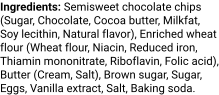

An ingredient list and a US “Contains” statement drawn by the maker. Most exemptions remove the nutrition panel, not these.
Making the ingredient and allergen text