FDA nutrition label generator for
US Nutrition Facts
Enter values per serving or per 100 g, or build them from a recipe, and get a Nutrition Facts panel with FDA rounding, % Daily Values and a format that fits your package.
Your values in, an FDA-format Nutrition Facts panel out.
“High in” sugars and sodium symbol required on the front of pack Health Canada’s official symbol 3(BH), 28 × 14.2 mm for this pack size.
What a US Nutrition Facts label must show
A US Nutrition Facts label starts with servings per container and the serving size, in a household measure first and the metric amount in brackets (“2 tbsp (34g)”). Then come Calories in large type and 14 nutrients in a fixed order. The FDA sets the order, the names, the units and the Daily Values in 21 CFR 101.9; the maker prints them exactly as below and leaves nothing to style.
Rows marked “Sometimes” stay off the label until a condition makes them mandatory, usually a claim on the package (“good source of fiber”, “low cholesterol”). Each one keeps its place in the order when it appears.
| Row on the label | Unit | Daily Value | Needed |
|---|---|---|---|
| Calories | Calories (no unit printed) | 2,000 Calories a day (footnote) | Always |
| Total Fat | g | 78 g | Always |
| Saturated Fat | g | 20 g | Always |
| Trans Fat | g | — | Always No Daily Value |
| Polyunsaturated Fat | g | — | Sometimes When monounsaturated fat is listed, or you make a fatty acid or cholesterol claim |
| Monounsaturated Fat | g | — | Sometimes When polyunsaturated fat is listed, or you make a fatty acid or cholesterol claim |
| Cholesterol | mg | 300 mg | Always |
| Sodium | mg | 2,300 mg | Always |
| Fluoride | mg | — | Sometimes When you make a claim about fluoride |
| Total Carbohydrate | g | 275 g | Always |
| Dietary Fiber | g | 28 g | Always |
| Soluble Fiber | g | — | Sometimes When you make a soluble fiber claim |
| Insoluble Fiber | g | — | Sometimes When you make an insoluble fiber claim |
| Total Sugars | g | — | Always No Daily Value |
| Includes Added Sugars | g | 50 g | Always |
| Sugar Alcohol | g | — | Sometimes When you make a claim about sugar alcohol or sugars (or added sugars, if the food has sugar alcohols) |
| Protein | g | 50 g | Always %DV only with a protein claim (needs a protein quality score; not printed by the maker) |
| Vitamin D | mcg | 20 mcg | Always |
| Calcium | mg | 1,300 mg | Always |
| Iron | mg | 18 mg | Always |
| Potassium | mg | 4,700 mg | Always |
Daily Values: 21 CFR 101.9(c)(8)(iv) and (c)(9), adults and children 4 years and older, 2,000 Calories. Read from the maker’s US rule data.
Daily Values of the other 23 vitamins and minerals
These print only when the nutrient is added to the food or you make a claim about it, after potassium and in this order.
| Nutrient | Daily Value | Amount rounded to |
|---|---|---|
| Vitamin A | 900 mcg | 10 mcg |
| Vitamin C | 90 mg | 1 mg |
| Vitamin E | 15 mg | 0.1 mg |
| Vitamin K | 120 mcg | 1 mcg |
| Thiamin | 1.2 mg | 0.01 mg |
| Riboflavin | 1.3 mg | 0.01 mg |
| Niacin | 16 mg | 0.1 mg |
| Vitamin B6 | 1.7 mg | 0.01 mg |
| Folate | 400 mcg | 5 mcg |
| Vitamin B12 | 2.4 mcg | 0.01 mcg |
| Biotin | 30 mcg | 0.1 mcg |
| Pantothenic Acid | 5 mg | 0.1 mg |
| Phosphorus | 1,250 mg | 10 mg |
| Iodine | 150 mcg | 1 mcg |
| Magnesium | 420 mg | 5 mg |
| Zinc | 11 mg | 0.1 mg |
| Selenium | 55 mcg | 1 mcg |
| Copper | 0.9 mg | 0.01 mg |
| Manganese | 2.3 mg | 0.01 mg |
| Chromium | 35 mcg | 0.1 mcg |
| Molybdenum | 45 mcg | 0.1 mcg |
| Chloride | 2,300 mg | 10 mg |
| Choline | 550 mg | 10 mg |
21 CFR 101.9(c)(8)(iv); FDA Nutrition and Supplement Facts Q&A (recommended increments).
Serving size comes from the reference amounts (RACC)
You don’t pick the serving size freely. 21 CFR 101.12 gives a reference amount customarily consumed (RACC) for 146 food categories, and the label serving is the household measure closest to it. In the maker you choose your food from a plain-language list (“BBQ sauce”, “granola”, “cookies”); it maps that to the right RACC row and suggests the serving. If your product sits in a different FDA category, you can pick the exact row under Advanced and the maker uses that one instead.
For the sample BBQ sauce the maker reports: 2 tbsp: Barbecue sauce, hollandaise sauce, tartar sauce, tomato chili sauce, other sauces for dipping (e.g., mustard sauce, sweet and sour sauce), all dips (e.g., bean dips, dairy-based dips, salsa). Your serving is 98.6% of it. The label serving is 2 tbsp (34g), and for the 12 oz (340 g) bottle: 340 g ÷ 34 g = 10 → "10 servings per container"
The package size, as a share of the reference amount, decides how many columns the label needs:
| Package holds | What the label shows | Rule |
|---|---|---|
| Less than 200% | A single-serving container: the whole package is one serving. | 21 CFR 101.9(b)(6) |
| 150% to 200% | Still one serving; you may add a second column for the reference amount. | 21 CFR 101.9(e); 101.9(b)(10) |
| 200% to 300% | Dual column required: one column per serving, one for the whole package. | 21 CFR 101.9(b)(12)(i), (e)(6)(i) |
| More than 300% | Per serving, with servings per container; a whole-package column is optional. | 21 CFR 101.9(b)(8)(i)–(v) |
Household measures use the steps FDA allows, and the maker converts them with FDA’s own equivalents, never with a guess at density:
| Measure | Allowed amounts | Equivalent |
|---|---|---|
| Cup | 1/4, 1/3, 1/2, 2/3, 3/4, 1, 1 1/4, 1 1/3, 1 1/2, 1 2/3, 1 3/4, 2 … | 1 cup = 240 mL |
| Tablespoon | 1, 1 1/3, 1 1/2, 1 2/3, 2, 3 | 1 tbsp = 15 mL |
| Teaspoon | 1/8, 1/4, 1/2, 3/4, 1, 2 | 1 tsp = 5 mL |
| Fluid ounce | for beverages | 1 fl oz = 30 mL |
| Ounce (weight) | 0.5 oz steps with a visual unit, only when no cup, spoon, piece or slice fits | 1 oz = 28 g |
FDA rounding, applied for you
Every number on a US panel is rounded to an FDA increment that depends on the nutrient and the amount. The maker stores your values unrounded and rounds once, at the end, per serving: it never rounds per 100 g first and then scales, which is how hand-made labels drift by a gram or a few Calories. Ties round half up.
| Nutrient | Rounding | Rule |
|---|---|---|
| Calories | Less than 5 Calories: print 0 5 to 50 Calories: nearest 5 Calories More than 50 Calories: nearest 10 Calories | 21 CFR 101.9(c)(1) |
| Total Fat, Saturated Fat, Trans Fat, Polyunsaturated Fat and Monounsaturated Fat | Less than 0.5 g: print 0 g 0.5 g to less than 5 g: nearest 0.5 g 5 g or more: nearest 1 g | 21 CFR 101.9(c)(2) |
| Sodium | Less than 5 mg: print 0 mg 5 to 140 mg: nearest 5 mg More than 140 mg: nearest 10 mg | 21 CFR 101.9(c)(4) |
| Total Carbohydrate, Soluble Fiber, Insoluble Fiber, Total Sugars, Added Sugars and Sugar Alcohol | Less than 0.5 g: print 0 g 0.5 g to less than 1 g: print “less than 1 g” 1 g or more: nearest 1 g | 21 CFR 101.9(c)(6) |
| Protein | Less than 0.5 g: print 0 g 0.5 g to less than 1 g: print “less than 1 g” 1 g or more: nearest 1 g | 21 CFR 101.9(c)(7) |
| % Daily Value of fat, saturated fat, cholesterol, sodium, carbohydrate, fiber and added sugars | Any amount: nearest 1% | 21 CFR 101.9(d)(7)(ii) |
| Nutrient | Unrounded | Printed |
|---|---|---|
| Calories | 47.5 | 50 |
| Calories | 55 | 60 |
| Total Fat | 0.49 g | 0g |
| Total Fat | 0.74 g | 0.5g |
| Total Fat | 0.75 g | 1g |
| Sodium | 137.4 mg | 135mg |
| Sodium | 137.5 mg | 140mg |
| Total Carbohydrate | 0.5 g | <1g |
Fiber, vitamin and mineral rows, the % Daily Values and servings per container have their own steps; all of them are in FDA rounding rules.
Choose a format that fits your package
FDA allows several layouts, but not freely: each one is tied to facts about your package. Tell the maker the labeling area and the space you have for the panel, and it offers only the formats your package may use. It never shrinks type below the legal minimums to make a panel fit (8 pt nutrients, 6 pt footnote, 16 pt “Calories” on the standard format). Below, each format is drawn by the maker for the sample sauce in a package where that format is allowed, with the reason the maker gives.
Standard vertical
The standard FDA format. It works on any package with about 3 in (76 mm) of height for the panel.
Shown for: the 12 oz BBQ sauce bottle as it is (no package limits given)
Vertical, vitamins side by side
The standard format with vitamins and minerals two per line, to save height.
Shown for: the same bottle
Dual column
Optional. You may show the whole package in a second column.
Shown for: the same bottle, with the whole-package column switched on
Simplified
8 of the 15 core nutrients are insignificant (at least 8 needed), so the shorter simplified format may be used.
Shown for: the same bottle: the sauce has 8 insignificant core nutrients
Tabular (horizontal)
Your space for the panel is less than about 3 in (76 mm) tall, so the tabular format may be used.
Shown for: a pack with a 180 × 50 mm space for the panel (under 3 in tall)
Small package, tabular
Your package has 31 sq in of labeling space and the larger formats don't fit, so this format may be used.
Shown for: a pack with 31 sq in (200 cm²) of labeling space and a 110 × 40 mm space for the panel
Linear (small package)
Your package has 31 sq in of labeling space and the larger formats don't fit, so this format may be used.
Shown for: a pack with 31 sq in of labeling space and a 120 × 25 mm strip for the panel
Linear, 6 pt (under 12 sq in)
Your package has 10.9 sq in of labeling space and the larger formats don't fit, so this format may be used.
Shown for: a pack with 10.9 sq in (70 cm²) of labeling space and a 120 × 15 mm strip
Packages under 40 sq in of labeling space may abbreviate (“Sat. Fat”, “Total Carb.”) and use the small formats; under 12 sq in, a package with no claims may print a phone number or address for nutrition information instead of a panel. The standard vertical format needs about 3 in (76 mm) of height. Not available in the maker yet: the dual-column tabular display, aggregate displays (several foods in one panel), “as prepared” columns, the Spanish bilingual panel and vitamin D in IU.
Type sizes, bar weights and widths for each format are in Nutrition Facts font and type sizes. If you need a layout to fill in by hand, there are blank Nutrition Facts templates.
Worked example: a 12 oz BBQ sauce
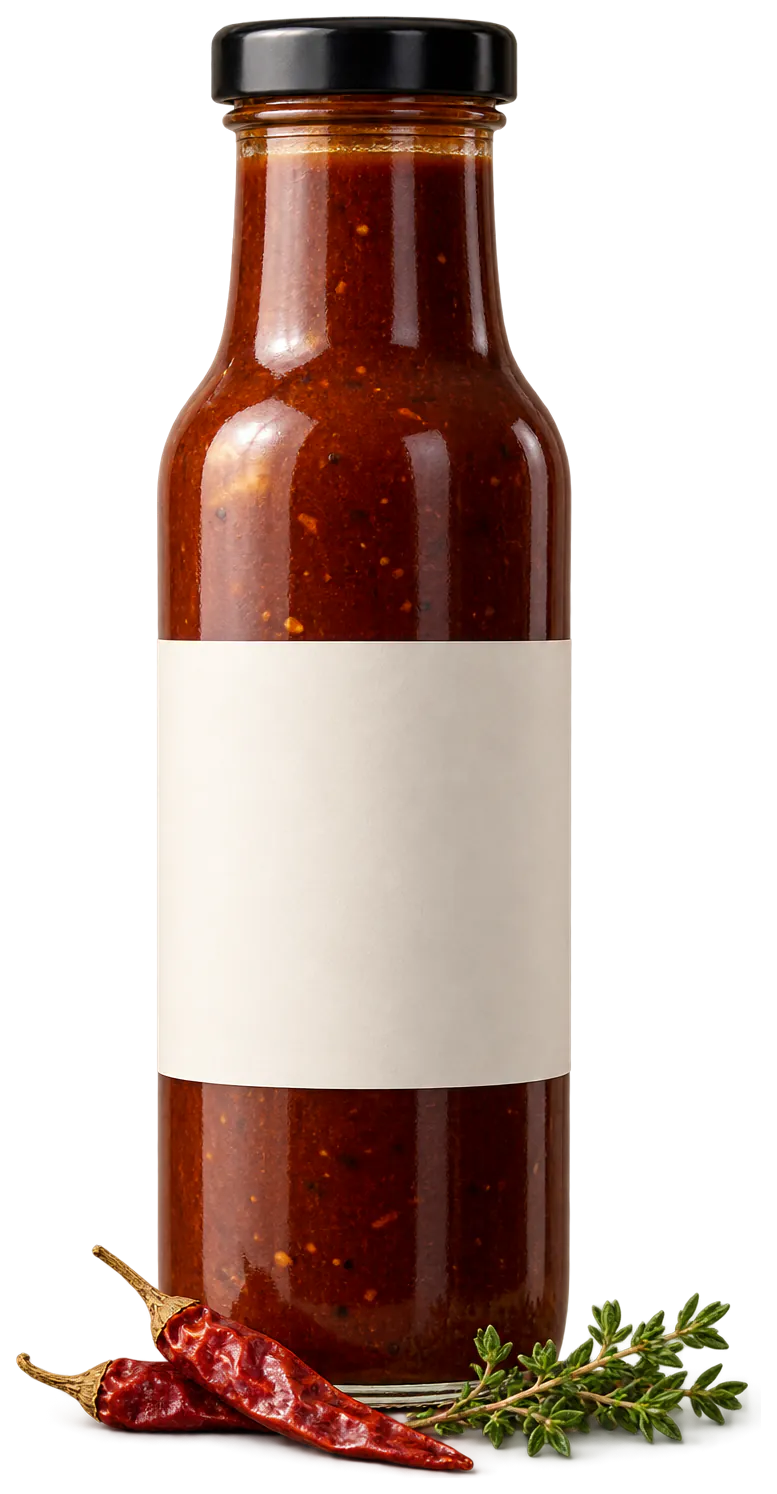
The sample Smoky BBQ Sauce is a tomato and molasses sauce in a 12 oz (340 g) bottle. Its values per 100 g come from a recipe of USDA ingredients. The serving is 2 tbsp (34g), so every value is multiplied by 0.34 (the 34 g serving over 100 g) and then rounded with the rule for its amount. Nothing is rounded twice.
| Row | Per 100 g | Per 34 g, unrounded | FDA rounding that applies | Label | %DV |
|---|---|---|---|---|---|
| Calories | 147.7 kcal | 50.22 kcal | More than 50 Calories: nearest 10 Calories | 50 | |
| Total Fat | 0.3093 g | 0.1052 g | Less than 0.5 g: print 0 g | 0g | 0% |
| Saturated Fat | 0.06182 g | 0.02102 g | Less than 0.5 g: print 0 g | 0g | 0% |
| Trans Fat | 0 g | 0 g | Less than 0.5 g: print 0 g | 0g | |
| Cholesterol | 0 mg | 0 mg | Less than 2 mg: print 0 mg | 0mg | 0% |
| Sodium | 936.8 mg | 318.5 mg | More than 140 mg: nearest 10 mg | 320mg | 14% |
| Total Carbohydrate | 36.31 g | 12.35 g | 1 g or more: nearest 1 g | 12g | 4% |
| Dietary Fiber | 1.925 g | 0.6545 g | 0.5 g to less than 1 g: print “less than 1 g” | <1g | 2% |
| Total Sugars | 32.28 g | 10.98 g | 1 g or more: nearest 1 g | 11g | |
| Added Sugars | 27.99 g | 9.517 g | 1 g or more: nearest 1 g | 10g | 20% |
| Protein | 1.79 g | 0.6086 g | 0.5 g to less than 1 g: print “less than 1 g” | <1g | |
| Vitamin D | 0 mcg | 0 mcg | Any amount: nearest 0.1 mcg | 0mcg | 0% |
| Calcium | 52.2 mg | 17.75 mg | Any amount: nearest 10 mg | 20mg | 2% |
| Iron | 1.738 mg | 0.5909 mg | Any amount: nearest 0.1 mg | 0.6mg | 4% |
| Potassium | 495.5 mg | 168.5 mg | Any amount: nearest 10 mg | 170mg | 4% |
Values per 100 g: the sample’s USDA FoodData Central recipe, frozen at 4 significant figures. Printed values and %DV read back from the maker’s US panel.
Three rows show why the order matters. Sodium is 318.5 mg per serving, above 140 mg, so it goes to the nearest 10 mg: 320mg, 14% of the 2,300 mg Daily Value. Dietary fiber is 0.6545 g, between 0.5 and 1 g, so the label says <1g, while its %DV (2%) is still worked out from the amount. Added sugars, 9.517 g from the brown sugar and molasses, print as “Includes 10g Added Sugars” with 20% of the 50 g Daily Value.
Added sugars, vitamin D and potassium
Added sugars sit under Total Sugars as “Includes Xg Added Sugars” with their own %DV (50 g). They are declared separately and are never worked out from total sugars: a tomato sauce’s total sugars include the tomato’s own sugar, which is not added. The maker counts sweeteners in a recipe (sugar, honey, syrups, molasses) as added sugar, counts single whole foods as none, and asks you for anything else instead of guessing. Pure single-ingredient sugars such as honey or maple syrup follow FDA’s special “†” statement; the maker flags them for review.
Vitamin D, calcium, iron and potassium are mandatory on every label, with amounts and %DV. Vitamin D is declared in micrograms (mcg, Daily Value 20 mcg); the maker does not print an extra IU amount. Potassium uses a Daily Value of 4,700 mg. Vitamins A and C are no longer required unless added or claimed, and “Calories from fat” was removed from the label by FDA’s 2016 rule, so the maker never prints it.
Ingredients and the 9 major allergens
The ingredient list runs in descending order of weight (21 CFR 101.4); compound ingredients carry their own list in brackets. The US has nine major food allergens (FD&C Act 403(w)): milk, egg, fish, crustacean shellfish, wheat, peanuts, soy, sesame and tree nuts, where the label names the nut (almonds, Brazil nuts, cashews, hazelnuts …). Fish and crustacean shellfish are named by species too. Molluscs, mustard and celery are not major allergens in the US, so they appear only in the ingredient list.
You can declare allergens inside the list (“whey (milk)”) or in a “Contains” statement right after it, in type no smaller than the list. The maker writes the Contains statement from the allergens you confirm for each ingredient. It suggests them from ingredient names but never adds one, or a “may contain” line, without you. Build just the ingredient list and Contains statement.
FDA or USDA: which agency covers your label?
The FDA covers most packaged foods: sauces, snacks, baked goods, cereals, soft drinks, dairy, and fish other than catfish. USDA’s Food Safety and Inspection Service (FSIS) covers meat, poultry and processed egg products under its own regulations (9 CFR), and this maker does not make FSIS labels: choose a meat or poultry category and it tells you plainly that it doesn’t make that label.
There is no separate “USDA nutrition label”. The USDA organic seal is a marketing mark for organic products with a valid organic certification, not a nutrition panel; the maker adds it only after you confirm your certification details. Who may use it is explained in the USDA organic seal guide.
What we check, and what you still check
Every label in the maker carries one of three statuses. Here is what each means for a US label:
-
Needs values
Something the US label must print is missing, such as a nutrient, the serving size or the category. Empty fields are never turned into zeros.
-
Needs review
The label can be drawn, but one answer only you can give is open, or a rule leaves room for judgement. The maker says what to check.
-
Ready for the supported output
Every check the maker runs for this market passed for the formats it makes. It is still your label: check it before printing.
What the maker checked for the sample sauce
- Product type. An FDA-regulated food for the general population (adults and children 4 years and older).
- Serving size statement. 2 tbsp (34g)
- Reference amount (RACC). 2 tbsp: Barbecue sauce, hollandaise sauce, tartar sauce, tomato chili sauce, other sauces for dipping (e.g., mustard sauce, sweet and sour sauce), all dips (e.g., bean dips, dairy-based dips, salsa). Your serving is 98.6% of it.
- Package size. The package is 986% of the reference amount: a multi-serving package.
- Servings per container. 340 g ÷ 34 g = 10 → "10 servings per container"
- Format. Standard vertical. The standard FDA format. It works on any package with about 3 in (76 mm) of height for the panel.
- Mandatory nutrients. Calories, total fat, saturated fat, trans fat, cholesterol, sodium, total carbohydrate, dietary fiber, total sugars, added sugars, protein, vitamin D, calcium, iron and potassium are all given.
- Rounding. Each amount rounded once with its 21 CFR 101.9(c) increment (half up), from unrounded values.
- Daily Values. FDA Daily Values for adults and children 4 years and older (2,000 Calories). %DV from the declared amounts.
- Conversions. per 100 g → per serving (34 g) (× 0.34)
- Type sizes and rules. Set at or above the FDA minimum point sizes (8 pt nutrients, 6 pt footnote, 16 pt Calories with a 22 pt numeral in the standard format), with 0.25 pt hairlines and 3 pt and 7 pt bars. Never shrunk below them.
- Major food allergens. You confirmed the allergen sources; the nine major allergens (including sesame) are declared in a "Contains" statement.
What you still check
- Protein %DV. Not shown: the protein %DV is voluntary without a protein claim and needs a protein quality score (PDCAAS).
- Exemptions. Not checked: small businesses (sales to consumers up to $500,000, or food sales up to $50,000) and low-volume products (fewer than 100 full-time employees and 100,000 units a year, with a notice to FDA) may be exempt if they make no nutrition claims. We make the label either way.
- Your values. Recipe values are calculated from USDA ingredient data; cooking, moisture loss and supplier differences change real values, and a lab analysis is the reference.
- The rest of the package. Statement of identity, net quantity and the name and address of the business are separate parts of the label.
Not sure you need a panel at all? Read about the small business exemption.
Questions about US nutrition labels
What are the FDA requirements for a nutrition label?
Packaged foods sold in the US need a Nutrition Facts label laid out as 21 CFR 101.9 describes: a serving size based on the reference amount for that kind of food (21 CFR 101.12), the mandatory nutrients with % Daily Values, FDA rounding, and a permitted format with minimum type sizes. Ingredients, allergens, net quantity and the manufacturer’s name and address are separate required parts of the package label.
Which nutrients are required on a Nutrition Facts label?
Calories, total fat, saturated fat, trans fat, cholesterol, sodium, total carbohydrate, dietary fiber, total sugars, added sugars, protein, vitamin D, calcium, iron and potassium. A few may be left off with a “Not a significant source of …” statement when the amount is tiny and you make no claim about them.
What is not legally required on a Nutrition Facts label?
Calories from fat are gone from the label, and vitamins A and C are no longer required unless they are added or you make a claim about them. Protein %DV, polyunsaturated and monounsaturated fat, soluble and insoluble fiber and sugar alcohol are voluntary unless you make a claim about them. Protein %DV is also required on foods for children under 4, which this maker does not cover.
Does the FDA approve nutrition labels?
No. The FDA does not review or approve Nutrition Facts labels before a product goes on sale. The business selling the food is responsible for the label being accurate and correctly formatted. The FDA doesn’t look at labels made here either: the maker applies the published rules and tells you what it checked.
When do I need a dual column label?
When a package holds at least 200% and up to 300% of the reference amount, it could be eaten in one sitting, so the label needs two columns: one per serving and one for the whole package (21 CFR 101.9(b)(12)). Larger packages may add the second column voluntarily, and single-serving containers between 150% and 200% may add a column for the reference amount. The maker works this out from the net quantity, the serving and the category.
What is the 5/20 rule on food labels?
It’s the FDA’s quick guide to % Daily Value for shoppers: 5% DV or less of a nutrient per serving is considered low, and 20% DV or more is considered high. It is consumer advice, not a labeling rule.
Do small food businesses need a Nutrition Facts label?
Not always. FDA rules exempt some small businesses (for example sales to consumers of no more than $500,000 a year, or food sales of no more than $50,000) and low-volume products (fewer than 100 full-time-equivalent employees and fewer than 100,000 units a year, with a notice to FDA), but the exemption is lost if you make a nutrient content or health claim. See our guide to who needs a nutrition label.