The short answer
Only products certified under the USDA National Organic Program in the “100 percent organic” or “organic” (at least 95% organic ingredients) categories may show the USDA organic seal. “Made with organic …” products (at least 70%) may not, and every certified product names its certifier on the label: “Certified organic by …”.
The four organic labeling categories
The category depends on the share of organic ingredients, by weight, leaving out water and salt (7 CFR 205.301–205.305). The share is rounded down: 94.9% counts as 94%, which puts a product in the “made with” category, not “organic”.
| Category | Organic content | USDA seal | What the label may say |
|---|---|---|---|
| 100 percent organic | 100% (processing aids too) | Allowed | “100 percent organic” on the front; organic ingredients identified in the list; “Certified organic by …” |
| Organic | At least 95% | Allowed | “Organic” on the front; organic ingredients identified in the list; “Certified organic by …” |
| Made with organic (specified ingredients or food groups) | At least 70% | Not allowed | Up to three organic ingredients or food groups named on the front; organic ingredients identified in the list; “Certified organic by …” |
| Less than 70% organic | Under 70% | Not allowed | Organic ingredients may be named only in the ingredient list; no organic claim on the front |
Organic ingredients are identified in the ingredient list with the word “organic” or an asterisk; water and salt are never marked. Operations exempt from certification (organic sales of $5,000 or less a year) may sell as organic but may never use the seal.
What the seal looks like
There is one design, in two permitted versions: four-color, in PMS 348 green and PMS 175 brown, or black and white. Either may be shown with or without the ® registration mark. The rules set no minimum size and no clear space, but the seal must keep its form and design: no recoloring beyond these versions and no redrawing. These are the official files from the USDA Agricultural Marketing Service, shown unaltered:
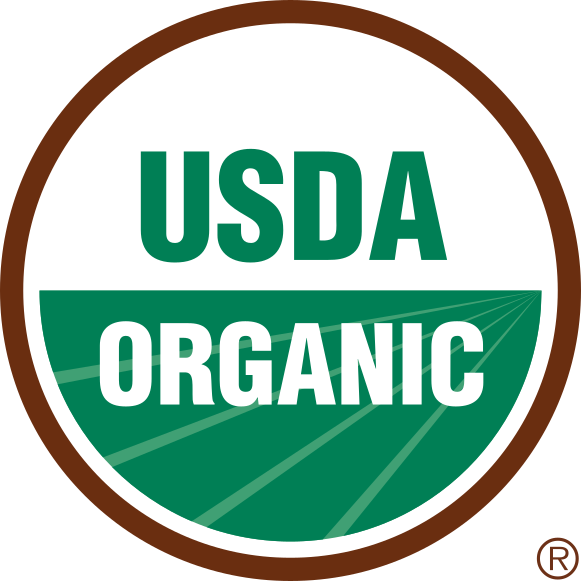
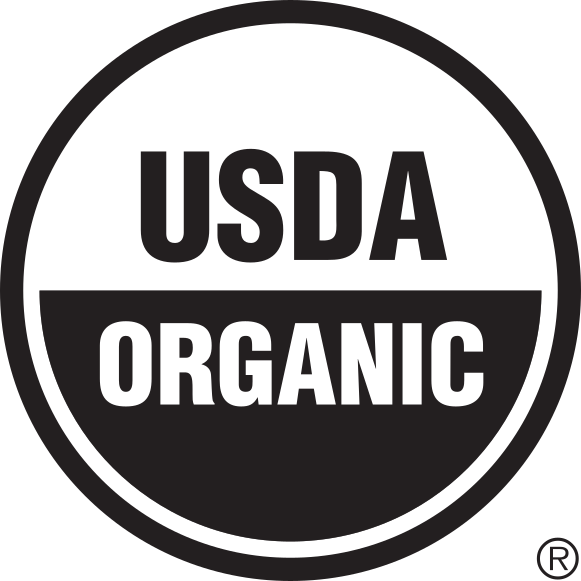
Official artwork: USDA Agricultural Marketing Service, National Organic Program. Shown here only to explain the seal; it may appear on a product only under the rules above.
The certifier statement
Every certified product, in the “100 percent organic”, “organic” and “made with organic” categories, must name its certifying agent on the information panel, below the name of the handler or distributor (7 CFR 205.303(b)(2) and 205.304(b)(2)):
On the information panelCertified organic by [name of your certifying agent]
The statement is required even when the seal isn’t used. Your certifier must also approve the label before you print it.
How certification works
Certification is done by certifying agents accredited by the USDA, not by the USDA itself. In outline, you apply to a certifier, describe your practices in an organic system plan, are inspected, and renew every year; the certifier also reviews your labels. Costs depend on the certifier and the size of your operation, so ask more than one for a quote. The USDA has run cost-share programs that refund part of the fee; the Agricultural Marketing Service lists what is open now.
Adding the seal with Nutritional Label Maker
The maker treats the seal as a permission, not a decoration. In the Label step of your US label:
- Answer “Is this product certified organic by a USDA-accredited certifier?”. If not, nothing more is shown.
- Choose the claim: 100% organic, organic, or made with organic.
- Enter your certifier’s name and your certificate or operation ID.
- Confirm that the product is certified for this claim and that your certifier approved the label.
Only then is the official seal added, for “100 percent organic” and “organic” products, with the “Certified organic by …” line to place under your business name. For “made with organic” the maker adds the statement and explains why there is no seal: “Products "made with organic …" (at least 70% organic) may not use the USDA seal.” Until every detail is in, the label shows “Needs review” and lists what is missing.
Only certified products
To start, open the maker, or see how to make your US Nutrition Facts label first. The rest of the label is covered in how to make a nutrition label.
What the seal does not mean
- It isn’t a nutrition or safety approval. It says how the food was produced and handled, nothing about calories, sugar or safety.
- There is no USDA “approved nutrition label” seal. No agency approves Nutrition Facts labels or issues a mark for them.
- It isn’t a meat inspection mark. The USDA’s Food Safety and Inspection Service uses separate inspection legends on meat, poultry and egg products, under different rules (and those products are outside what this maker covers).