Ingredient label maker with
allergen statements
List your ingredients by weight, confirm the allergens, and get the ingredient statement and allergen text each market expects, ready to place next to your nutrition panel.
Ingredient lists and allergen text for each market.
“High in” saturated fat and sugars symbol required on the front of pack Health Canada’s official symbol 2(BH), 45 × 23.6 mm for this pack size.
-
Each market’s rules
US, UK, EU, Canada, Australia and New Zealand: the right allergen list and the right way to show it.
-
Order and sub-ingredients
Ingredients by weight, compound ingredients with their own list in brackets, percentages where needed.
-
Allergens suggested
Likely allergens are flagged from each name. Nothing is final until you confirm it.
-
Text or artwork
Copy the text, or download the block as PDF, SVG or PNG at the width of your panel.
How it works
It writes the ingredient and allergen text for your label. It doesn’t print stickers: you place the text in your artwork or send the file to your printer.
-
Step 1: List your ingredients
Add them heaviest first, with their weights or percentages, and the ingredients of any compound ingredient.
-
Step 2: Confirm the allergens
The maker suggests allergens from each name. You confirm each one, name the specific nut or fish, and add a “may contain” line only if you choose to.
-
Step 3: Get each market’s text
See the ingredient list and allergen statement for each market you sell in, then copy it or download it with your nutrition panel.
How to write an ingredient list
How to write an ingredients list, in five steps:
- Weigh what goes in. List every ingredient by its common name, from the heaviest to the lightest, as weighed when the food is made.
- Open up compound ingredients. Follow an ingredient that has its own ingredients (chocolate chips, a sauce) with them in brackets, again by weight.
- Name additives the market’s way, and count added water as an ingredient unless it is driven off again.
- Show the allergens the way the market asks: in bold in the list, in a “Contains” statement, or both.
- Add percentages and languages where the market needs them: the percentage of a highlighted ingredient, and the label language of the country you sell in.
Order by weight
All six markets list ingredients from the largest to the smallest amount by weight. The details differ:
- United States: descending order of predominance by weight. Water added in making the food is an ingredient unless it is removed again (21 CFR 101.4(a)).
- UK and EU: descending order of weight as recorded when the ingredients are used. Added water under 5% of the finished product may be left out, and ingredients under 2% may follow in any order (Regulation (EU) No 1169/2011, Article 18 and Annex VII).
- Canada: descending order of proportion by weight, before the ingredients are combined; spices, flavors, additives, vitamins and minerals may go at the end in any order (Food and Drug Regulations, B.01.008.2).
- Australia and New Zealand: descending order of ingoing weight; added water counts as the amount added minus any removed (Standard 1.2.4).
Compound ingredients
Name the compound ingredient, then its own ingredients in brackets, in order of weight. Some markets let you leave out the sub-list of a small one: in the UK and EU, for example, certain compound ingredients under 2% of the food; in Australia and New Zealand, a compound ingredient under 5% only needs its allergens, the additives that still have a function in the food and any GM food declarations. Allergens are never left out.
Additives
In the US, a chemical preservative is named with its function, such as “sodium benzoate (preservative)”. In Australia and New Zealand an additive goes under its class name with its name or code number: “emulsifier (322)” or “emulsifier (soy lecithin)”. The maker prints the names you give it, so write them the way your market expects.
Percentages (QUID)
In the UK and EU, the percentage of an ingredient is required when it appears in the name of the food, is emphasized in words or pictures, or characterizes the food (Article 22, Annex VIII). Australia and New Zealand have the same idea for characterizing ingredients (Standard 1.2.10). The US has no general requirement, but allows a voluntary percentage to the nearest 1%; Canada has none except for a few cases such as nut mixtures.
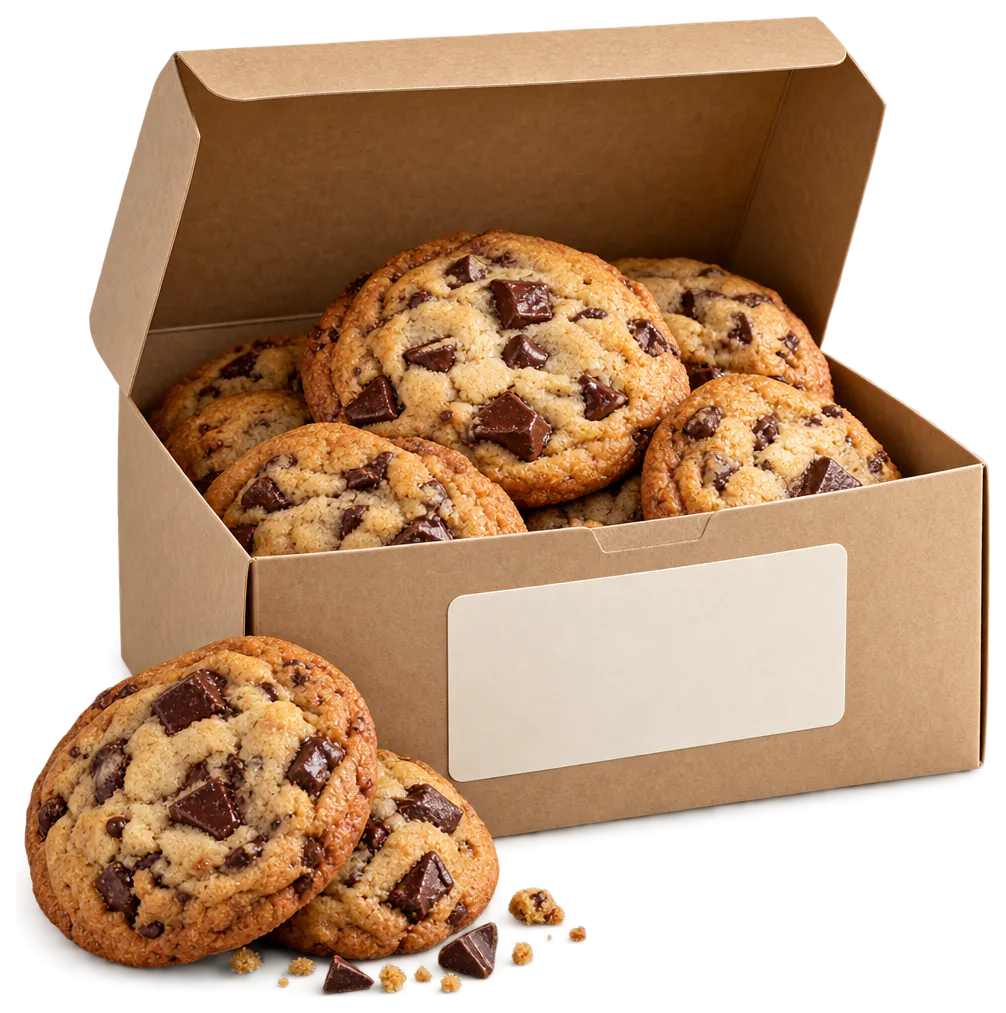
Chocolate chip cookies are named after the chips, so in the UK their percentage goes next to them. Marked in the maker, the chips are 27% of the ingoing weight of our sample recipe:
Specific names
Some allergens must be named precisely. In the US, the label names the type of tree nut (almonds, Brazil nuts and cashews and so on), the species of fish and the species of crustacean shellfish. Canada names the species of fish, crustacean and mollusc. In the UK and EU, “nuts” means the eight named in Annex II, each given by name. The maker asks for the specific source when the market needs it.
Two languages in Canada
Canadian labels carry the list in English and in French. Each language’s list is followed by its own “Contains” / “Contient” statement, inside the same border or background, and allergens are not set in bold inside the list. Sugars-based ingredients are grouped after the word “Sugars” / “Sucres” (B.01.008.3): our cookies’ brown sugar and sugar print as “Sugars (brown sugar, sugar)”.
EU languages
In the EU the list must be in a language the buyers in that country understand, usually set by national law. The maker knows the rule for each of the 27 member states and translates the fixed words and the allergen names; you give the ingredient names in that language. For Austria, Cyprus, Luxembourg, Portugal and Romania, the national rule is not verified yet, so labels for those countries show “Needs review”.
Allergen rules by market
Each market has its own list of allergens and its own way of showing them. The lists below are the ones the maker uses.
| Market | Allergens | How they appear |
|---|---|---|
| United States | 9 major food allergens: milk, egg, fish, crustacean shellfish, peanuts, soy, sesame, wheat and tree nuts (the specific nut). Fish and crustacean shellfish by species. | A “Contains” statement after the list that names every major allergen, or the source in brackets after the ingredient (“whey (milk)”), or both. |
| Canada | Priority food allergens (almonds, Brazil nuts, cashews, hazelnuts, macadamia nuts and pecans and more), gluten sources (barley, oats, rye, triticale and wheat) and added sulphites from 10 ppm. | In brackets in the list, or in a “Contains” statement after it; if you use one it must list them all. English and French; no bold inside the list. |
| UK and EU | 14 allergens (Annex II): cereals containing gluten, crustaceans, eggs, fish, peanuts, soybeans, milk, nuts, celery, mustard, sesame seeds, sulphur dioxide and sulphites, lupin and molluscs. | Emphasized (for example in bold) inside the ingredient list every time they appear. No separate “Contains” statement when there is a list. |
| Australia and New Zealand | Plain English allergen labelling (PEAL): wheat, barley, oats, rye, almond, Brazil nut, cashew and hazelnut, and the other required names. | The required name in bold in the list, plus a bold summary statement next to it that starts with “Contains” and has no other words. |
Sources: FD&C Act 403(w), Food and Drug Regulations B.01.010.1–B.01.010.3, Regulation 1169/2011 as it applies in Great Britain, Regulation (EU) No 1169/2011, Article 21 and Annex II, Food Standards Code Standard 1.2.3.
Worked example: chocolate chip cookies
One recipe, four markets. These blocks are the maker’s own output for our sample chocolate chip cookies. Look at the compound chocolate chips, and at how wheat, milk, egg and soy are handled in each market.
United States
Great Britain
Canada
Australia
The same cookies for Germany, in German. The ingredient names come from the product record; the heading and the allergen emphasis come from the engine:
Allergens are suggested, you confirm
When you type an ingredient, the maker looks for likely allergens in its name and suggests them. A suggestion is only a suggestion: nothing goes on the label until you confirm it, and the maker never writes “allergen-free”, “gluten-free” or “may contain” for you.
| You type | The maker suggests |
|---|---|
| Whey powder | milk |
| Tahini | sesame |
| Spelt flour | spelt |
| Wine vinegar | sulphites |
| Semisweet chocolate chips | Nothing |
| Coconut milk | Nothing |
* Wine vinegar: “Wine usually contains added sulphites above 10 mg/L — check the finished product.”
Two of these show why you confirm every allergen yourself. “Semisweet chocolate chips” name no allergen, but their own ingredients include milkfat and soy lecithin, so the sub-ingredients carry the allergens. “Coconut milk” is not milk. Your supplier’s specification is the reference.
‘May contain’ statements
“May contain” (precautionary) statements are voluntary. Use one only when your own risk assessment finds a cross-contact risk you can’t remove, and never for an allergen that is an ingredient. The maker doesn’t add them; you can add your own wording, and it prints apart from the required statements.
- United States: not covered by the allergen law; allowed if truthful and not misleading, and not a substitute for good manufacturing practice.
- Canada: voluntary, placed right after the Contains statement (or the list), in both languages when the list is bilingual (B.01.010.4).
- UK: voluntary after a risk assessment; name the allergen (“may contain peanuts”), and don’t combine it with a “free from” claim for the same allergen.
- EU: voluntary information that must not mislead (Article 36).
- Australia and New Zealand: not regulated by the Food Standards Code; it never goes inside the “Contains” summary statement.
Download the ingredient block
Download the ingredient and allergen block on its own or with your nutrition panel, as a PDF at its exact size, an SVG or a PNG, or copy the plain text. The text is set to the width you give it and checked against the market’s minimum type size:
- US: lower-case letters at least 1/16 in tall, which in the label font is 8.22 pt; the maker sets 8.5 pt.
- UK and EU: an x-height of at least 1.2 mm, or 0.9 mm when the largest surface of the pack is under 80 cm².
- Canada: an x-height of at least 1.1 mm for the list (1.4 mm when the Nutrition Facts table uses 8 pt type).
- Australia and New Zealand: no minimum size in the Code; the bold allergen names and summary use the same size as the list.
If the text doesn’t fit at the minimum size, the maker says so instead of shrinking it. Building and checking need no account; downloading the files needs a free account, so your product and every version you download are saved.
What the maker checks, and what you check
Supplements, infant foods, medical foods, alcohol and other special categories are not supported.