UK nutrition label generator for
GB and Northern Ireland
Choose Great Britain or Northern Ireland, enter values or a recipe, and get the nutrition table per 100 g with salt and reference intakes, plus the 14 allergens emphasized in your ingredient list.
Per 100 g nutrition tables for GB and Northern Ireland.
“High in” saturated fat symbol required on the front of pack Health Canada’s official symbol 5(BH), 36 × 18.9 mm for this pack size.
Great Britain or Northern Ireland?
The UK has two sets of food labelling rules. Great Britain (England, Scotland and Wales) follows Regulation (EU) No 1169/2011 as assimilated law: the EU text as it stood at the end of 2020, amended since only by GB legislation. Northern Ireland keeps applying the current EU Regulation, including later EU amendments, under the Windsor Framework.
Today the nutrition tables are built the same way, so the two labels below look alike. The maker still keeps them as two profiles with their own rule versions: the rules around the panel already differ, and the panel itself can diverge with the next change on either side. Choose UK in the maker for Great Britain, or start a Northern Ireland label. Goods made in GB and moved to Northern Ireland shops under the NI Retail Movement Scheme may keep their GB label (with “Not for EU” where the scheme asks for it); you decide that per product.
| Topic | Northern Ireland | Great Britain |
|---|---|---|
| Legal text | EU Reg 1169/2011 incl. EU amendments (e.g. 2024/2512) | Assimilated GB text |
| Mustard behenic acid exception | Applies from 1 April 2025 | Does not apply |
| FBO address | NI or EU (else NI/EU importer) | UK (else UK importer) |
| Organic | EU logo compulsory; XI-ORG-XX; 'UK (NI) Agriculture' / 'EU Agriculture' / 'non-EU Agriculture' / 'EU or non-EU Agriculture' options | EU logo optional; GB-ORG-XX; 'UK Agriculture' etc. |
| Origin naming | 'UK(NI)' | 'UK'/'United Kingdom' |
| Route | NIRMS goods may instead carry the GB label + 'Not for EU' | n/a |
| Nutrition panel (content, order, RIs, factors, rounding, x-height) | Identical to GB and EU | Identical |
Selling in Ireland or elsewhere in the EU? The table is the same, but the language follows the member state: EU nutrition label generator.
What a UK nutrition declaration must show
A UK nutrition declaration has seven mandatory items, always in this order: energy (kJ and kcal), fat, saturates, carbohydrate, sugars, protein and salt, given per 100 g (or 100 ml for drinks). You may add values per portion, %RI and a short list of extra nutrients, each in its fixed place. Nothing else may go in the table: trans fat, cholesterol, sodium and added sugars are not allowed there, and the maker leaves them out.
| Row on the label | Unit | Reference intake | Needed |
|---|---|---|---|
| Energy | kJ and kcal | 8,400 kJ / 2,000 kcal | Always |
| Fat | g | 70 g | Always |
| of which saturates | g | 20 g | Always |
| of which mono-unsaturates | g | — | Sometimes Voluntary |
| of which polyunsaturates | g | — | Sometimes Voluntary |
| Carbohydrate | g | 260 g | Always |
| of which sugars | g | 90 g | Always |
| of which polyols | g | — | Sometimes Voluntary |
| of which starch | g | — | Sometimes Voluntary |
| Fibre | g | — | Sometimes Voluntary; needed when you make a fibre claim |
| Protein | g | 50 g | Always |
| Salt | g | 6 g | Always |
| Vitamins and minerals | mg or µg | NRV per nutrient | Sometimes Only when present in a significant amount (27 listed in Annex XIII) |
Assimilated Regulation (EU) No 1169/2011 Articles 30 and 32, Annexes XIII and XV, read from the maker’s GB rule data.
Carbohydrate here means available carbohydrate: if your values come from a US-style “total carbohydrate” that includes fibre, the maker subtracts the fibre and records the conversion. Energy is always worked out from fat, carbohydrate, protein and fibre with the legal factors, even if you entered a value. The table is the standard layout; the linear layout (one running line) is allowed only when a table doesn’t fit, and the maker checks that from the space you give it.
Table
The standard format: a table with the numbers lined up, used whenever it fits. About 85.8 × 64 mm.
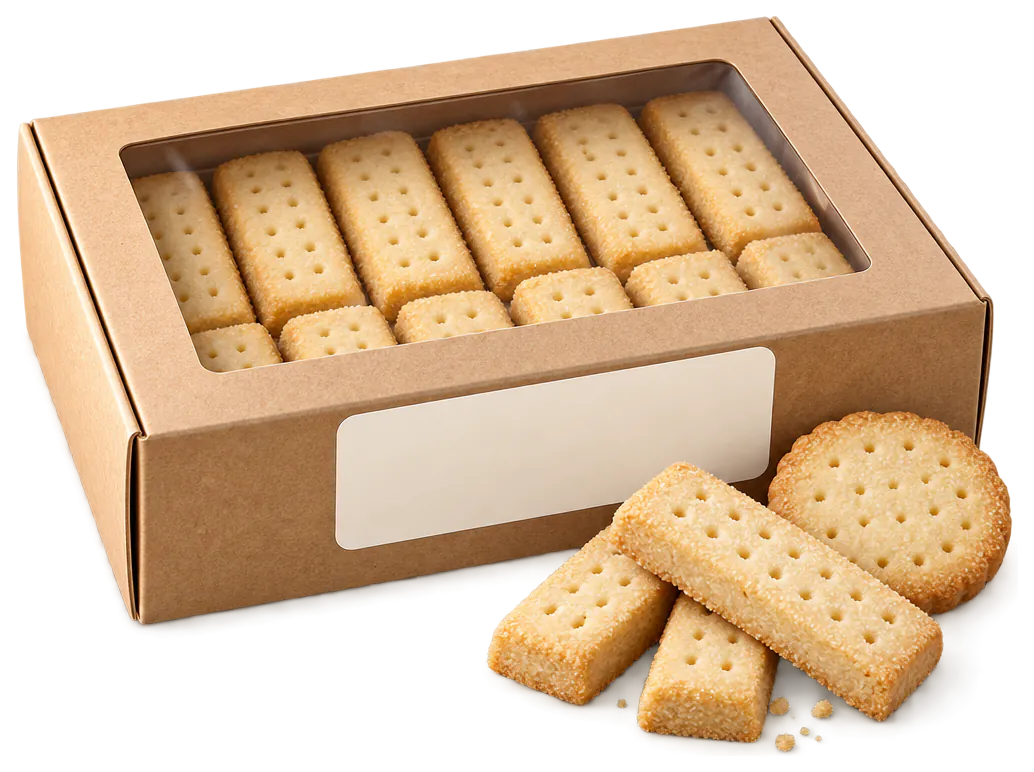
Shown for: the shortbread box, per 100 g and per biscuit with %RI
Linear
Allowed because the table doesn't fit your 75 × 45 mm space. About 75 × 37.5 mm.
Shown for: a pack with only a 75 × 45 mm space for the declaration
Salt, not sodium
UK and EU labels show salt, never sodium. Salt is sodium × 2.5, on the same basis and from the unrounded sodium, so the result is rounded once. For the sample shortbread, the maker records: salt 0.5212 g = sodium 208.5 mg × 2.5 per 100 g, printed as 0.52 g. Salt is rounded more finely than other nutrients:
| Salt, unrounded | Printed |
|---|---|
| 0.01 g | <0.01 g |
| 0.367 g | 0.37 g |
| 1.04 g | 1.0 g |
If all the sodium comes from the ingredients themselves, you may add a line next to the table saying so; the maker offers the UK guidance wording. Salt that comes from sodium-containing additives (baking soda, for example) still counts.
Reference intakes (%RI)
%RI tells shoppers how much of an average adult’s daily reference intake a portion (or 100 g) provides. It is optional on the back of pack, but if you show it, it uses these fixed reference intakes and the table must carry the statement “Reference intake of an average adult (8 400 kJ/2 000 kcal)”, which may not be reworded.
| Nutrient | Reference intake |
|---|---|
| Energy | 8,400 kJ / 2,000 kcal |
| Fat | 70 g |
| Saturates | 20 g |
| Carbohydrate | 260 g |
| Sugars | 90 g |
| Protein | 50 g |
| Salt | 6 g |
The maker works each %RI out from the declared (rounded) amount and rounds to a whole percent. One shortbread biscuit (25 g) has 4.2 g of saturates: 4.2 g ÷ 20 g = 21%. Its energy, 522 kJ/125 kcal, is 6% of 8,400 kJ.
Worked example: all-butter shortbread
The sample All-Butter Shortbread: a 200 g box of eight 25 g biscuits, made from flour, butter, sugar and rice flour (values per 100 g from a USDA recipe). The maker calculates energy from the nutrients with the legal factors, derives available carbohydrate and salt, rounds each value per 100 g and per biscuit separately, and adds %RI per biscuit. The result is the GB table shown at the top of this page. Fat, 26.75 g per 100 g, prints as 27 g; per biscuit it is 6.7 g.
| Row | Unrounded /100 g | per 100 g | per biscuit | %RI |
|---|---|---|---|---|
| Energy | 2,086 kJ / 498.9 kcal | 2086 kJ/499 kcal | 522 kJ/125 kcal | 6% |
| Fat | 26.75 g | 27 g | 6.7 g | 10% |
| of which saturates | 16.68 g | 17 g | 4.2 g | 21% |
| Carbohydrate | 58.03 g | 58 g | 15 g | 6% |
| of which sugars | 16.26 g | 16 g | 4.1 g | 5% |
| Fibre | 1.5 g | 1.5 g | <0.5 g | |
| Protein | 5.752 g | 5.8 g | 1.4 g | 3% |
| Salt | 0.5212 g | 0.52 g | 0.13 g | 2% |
Values per 100 g: the sample’s USDA FoodData Central recipe. Printed values read back from the maker’s GB table.
The ingredient list comes from the same product record. The maker emphasises the allergens in bold where they appear (here wheat and milk) and shows the butter percentage, because butter is named in the product’s name:
Front-of-pack traffic lights (optional)
The red, amber and green front-of-pack label is a voluntary UK scheme, set out in the government’s guide to creating a front of pack nutrition label. It repeats energy, fat, saturates, sugars and salt per portion with %RI, and colours the four nutrients by their amount per 100 g (or per portion, for big portions). If you use it you follow it in full, and it never replaces the back-of-pack table. The maker can add it to Great Britain labels; it doesn’t draw it for Northern Ireland, where its status under EU rules isn’t settled.
- Fat: HIGH 27 g per 100 g (over 17.5 g)
- Saturates: HIGH 17 g per 100 g (over 5 g)
- Sugars: MED 16 g per 100 g (over 5 g and ≤ 22.5 g)
- Salt: MED 0.52 g per 100 g (over 0.3 g and ≤ 1.5 g)
| Nutrient | Green (low) | Amber (medium) | Red (high) | Red per portion over 100 g |
|---|---|---|---|---|
| Fat | ≤ 3 g | > 3 to ≤ 17.5 g | > 17.5 g | > 21 g |
| Saturates | ≤ 1.5 g | > 1.5 to ≤ 5 g | > 5 g | > 6 g |
| Sugars | ≤ 5 g | > 5 to ≤ 22.5 g | > 22.5 g | > 27 g |
| Salt | ≤ 0.3 g | > 0.3 to ≤ 1.5 g | > 1.5 g | > 1.8 g |
Drinks have their own, lower thresholds per 100 ml. Both tables, the colours and the layout rules are in traffic light thresholds.
Allergens and Natasha's Law
UK law lists 14 allergens, and each one must be emphasised in the ingredient list every time it appears, usually in bold: “Butter (Cream (milk), Salt)”. A separate “Contains: …” box that repeats them is not the UK approach when the pack has an ingredient list; at most, a line such as “Allergy advice: for allergens, see ingredients in bold” may point to them. The maker emphasises the allergens you confirm, never guesses them, and never adds “may contain” on its own.
- Cereals containing gluten: wheat, spelt, khorasan wheat, rye, barley, oats
- Crustaceans
- Eggs
- Fish
- Peanuts
- Soybeans
- Milk
- Nuts: almonds, Brazil nuts, cashews, hazelnuts, macadamia nuts, pecan nuts, pistachio nuts, walnuts
- Celery
- Mustard
- Sesame seeds
- Sulphur dioxide and sulphites
- Lupin
- Molluscs
Natasha’s Law. Since 1 October 2021, food prepacked for direct sale (PPDS), made and packed on the premises where it is sold, such as a sandwich packed in the shop, must show the name of the food and a full ingredient list with the 14 allergens emphasised. The maker’s labels are made for prepacked food: its ingredient list follows the same emphasis rule, but it does not check the other PPDS requirements. The FSA’s allergen labelling guidance covers both. Read more about the 14 allergens. Or build the ingredient list with emphasized allergens on its own.
Text size and small packs
All mandatory information, the nutrition table included, needs an x-height of at least 1.2 mm, or 0.9 mm when the pack’s largest surface is under 80 cm². The x-height is the height of a lower-case “x”, so the point size depends on the typeface: in the label font the maker uses, 1.2 mm is 6.44 pt and 0.9 mm is 4.83 pt. The maker measures the real glyphs of every label it draws and flags anything smaller.
Packs whose largest surface is under 25 cm² don’t need a nutrition declaration at all, and under 10 cm² only the name, allergens, net quantity and date have to be on the pack. Tell the maker your pack’s largest surface and it applies the right minimum. How to measure it: minimum x-height.
What we check, and what you still check
-
Needs values
Something the UK label must print is missing, such as a nutrient, the serving size or the category. Empty fields are never turned into zeros.
-
Needs review
The label can be drawn, but one answer only you can give is open, or a rule leaves room for judgement. The maker says what to check.
-
Ready for the supported output
Every check the maker runs for this market passed for the formats it makes. It is still your label: check it before printing.
What the maker checked for the sample shortbread (GB)
- Label language. English.
- The seven mandatory items. Energy, fat, saturates, carbohydrate, sugars, protein and salt are all declared.
- Order and names. Annex XV order and the official English terms.
- Energy from the Annex XIV factors. kJ and kcal calculated separately from the unrounded components (fat 37/9, carbohydrate 17/4, protein 17/4, fibre 8/2, polyols 10/2.4, alcohol 29/7 kJ/kcal per g).
- Carbohydrate definition. Available carbohydrate = total carbohydrate − fibre (recorded as a conversion).
- Salt. Salt = total sodium × 2.5, from the unrounded sodium (recorded as a conversion).
- Rounding. EU guidance table (2012), half-up, band chosen from the unrounded value; per-portion values rounded on their own.
- Per 100 g / 100 ml. Values per 100 g and per portion (25 g).
- Reference intakes. Declared amount ÷ reference intake (8400 kJ, 70 g fat, 20 g saturates, 260 g carbohydrate, 90 g sugars, 50 g protein, 6 g salt), nearest whole %, with the fixed statement.
- Only permitted nutrients. Trans fat, cholesterol, sodium, added sugars and US-style total carbohydrate never appear in the table.
- Type size. Smallest text set with an x-height of at least 1.2 mm, measured from the label font; add your pack’s largest surface if it is under 80 cm² (0.9 mm then applies).
- Allergens emphasised in the ingredients. The 14 allergens are emphasised in bold in the list; no separate "Contains" list (not allowed when there is an ingredients list).
- Format. Table with the numbers aligned (the linear format is only allowed when a table does not fit).
What you still check
- Business address. Not part of this label. Your pack must show a UK name and address (yours, or your UK importer’s).
- UK traffic-light label (front of pack). Voluntary; not requested.
- Vitamins and minerals. None declared (only allowed when present in a significant amount).
- Your values. Recipe values are calculated from USDA ingredient data; cooking, moisture loss and supplier differences change real values, and a lab analysis is the reference.
- Exemptions. Whether your product is exempt (single-ingredient foods, small direct sales) is your call; making a claim always brings the declaration back.
Questions about UK nutrition labels
What must be on a UK nutrition label?
Energy in kJ and kcal, fat, saturates, carbohydrate, sugars, protein and salt, per 100 g or 100 ml, in that order. You can add per-portion values, %RI and certain extra nutrients (mono-unsaturates, polyunsaturates, polyols, starch, fibre, and vitamins and minerals present in a significant amount).
Is a UK nutrition label different from an EU one?
Today the panels look almost the same because Great Britain kept the EU rules as assimilated law. They are separate legal regimes, though: Northern Ireland follows current EU rules, Great Britain follows its own version, and the two can diverge (they already differ on a mustard allergen exception and on the business address required on the pack). The maker treats GB, NI and the EU as separate profiles.
Do I need a nutrition label to sell food in the UK?
Most prepacked food does. Exemptions include certain unprocessed single-ingredient foods, packs whose largest surface is under 25 cm², and small quantities supplied directly by the maker to the final consumer or to local shops that sell to consumers (UK government guidance reads “small” as a micro business and “local” as your county and its neighbours, or within 30 miles). Making a nutrition or health claim brings the requirement back.
Are traffic light labels mandatory in the UK?
No. The UK front-of-pack traffic light label is voluntary. If you use it, follow the government’s criteria for the colours and reference intakes in full. See the traffic light thresholds.
How do I convert sodium to salt?
Multiply sodium by 2.5 on the same basis: 0.4 g sodium per 100 g is 1.0 g salt per 100 g. The maker does this for you from the unrounded sodium and shows salt, not sodium, on UK and EU labels.
How many allergens must be declared in the UK?
Fourteen: celery, cereals containing gluten, crustaceans, eggs, fish, lupin, milk, molluscs, mustard, tree nuts, peanuts, sesame, soybeans, and sulphur dioxide and sulphites above 10 mg/kg or 10 mg/L. More in the 14 allergens.
What is Natasha's Law?
Since 1 October 2021, food prepacked for direct sale (made and packed on the same premises it’s sold from) must show its name and a full ingredient list with the 14 allergens emphasised. It is named after Natasha Ednan-Laperouse, who died in 2016 after an allergic reaction to sesame in a baguette.