The short answer
Each market rounds differently, so round once, at the end, from the unrounded value on the label’s own basis. US Calories round to the nearest 5 up to 50 and the nearest 10 above (below 5, 0). Canada uses similar bands with its own “free of” zeros. The UK and EU follow the Commission’s guidance table. Australia and New Zealand print no more than 3 significant figures.
The tables below are generated from the same rule data the maker uses to round every label, so they always match what it prints. Each band says which amounts it covers and what the label shows for them.
FDA rounding table
US labels round each amount per serving with the increments in 21 CFR 101.9(c). Pick the band from the unrounded amount; halfway values round up (0.5 → 1).
| Nutrient | Amount and rounding | Source |
|---|---|---|
| Calories | Less than 5 Calories: print 0 5 to 50 Calories: nearest 5 Calories More than 50 Calories: nearest 10 Calories | 21 CFR 101.9(c)(1) |
| Total Fat, Saturated Fat, Trans Fat, Polyunsaturated Fat and Monounsaturated Fat | Less than 0.5 g: print 0 g 0.5 g to less than 5 g: nearest 0.5 g 5 g or more: nearest 1 g | 21 CFR 101.9(c)(2) |
| Cholesterol | Less than 2 mg: print 0 mg 2 mg to less than 5 mg: print “less than 5 mg” 5 mg or more: nearest 5 mg | 21 CFR 101.9(c)(3) |
| Sodium | Less than 5 mg: print 0 mg 5 to 140 mg: nearest 5 mg More than 140 mg: nearest 10 mg | 21 CFR 101.9(c)(4) |
| Fluoride | Less than 0.1 mg: print 0 mg 0.1 to 0.8 mg: nearest 0.1 mg More than 0.8 mg: nearest 0.2 mg | 21 CFR 101.9(c)(5) |
| Total Carbohydrate, Soluble Fiber, Insoluble Fiber, Total Sugars, Added Sugars and Sugar Alcohol | Less than 0.5 g: print 0 g 0.5 g to less than 1 g: print “less than 1 g” 1 g or more: nearest 1 g | 21 CFR 101.9(c)(6) |
| Dietary Fiber | Less than 0.5 g: print 0 g 0.5 g to less than 1 g: print “less than 1 g” 1 g or more: nearest 1 g The nearest gram (“1g”) is also allowed between 0.5 and 1 g; the maker prints “<1g”. | 21 CFR 101.9(c)(6)(i) |
| Protein | Less than 0.5 g: print 0 g 0.5 g to less than 1 g: print “less than 1 g” 1 g or more: nearest 1 g | 21 CFR 101.9(c)(7) |
| % Daily Value of fat, saturated fat, cholesterol, sodium, carbohydrate, fiber and added sugars | Any amount: nearest 1% | 21 CFR 101.9(d)(7)(ii) |
| % Daily Value of vitamins and minerals | Up to 10%: nearest 2% More than 10% up to 50%: nearest 5% More than 50%: nearest 10% | 21 CFR 101.9(c)(8)(iii) |
| Serving size in grams or milliliters | Less than 2 g: nearest 0.1 g 2 g to less than 5 g: nearest 0.5 g 5 g or more: nearest 1 g | 21 CFR 101.9(b)(7)(ii) |
| Servings per container | Less than 2: nearest 1 2 to 5: nearest 0.5 More than 5: nearest 1 When the number was rounded, the label says “about”: “about 6 servings per container”. | 21 CFR 101.9(b)(8)(i) |
Vitamins and minerals are rounded to the increments FDA recommends for each one, and their %DV in the 2 / 5 / 10% steps above. The four that every label carries come first:
| Vitamin or mineral | Daily Value | Amount rounded to the nearest |
|---|---|---|
| Vitamin D (required) | 20 mcg | 0.1 mcg |
| Calcium (required) | 1,300 mg | 10 mg |
| Iron (required) | 18 mg | 0.1 mg |
| Potassium (required) | 4,700 mg | 10 mg |
| Vitamin A | 900 mcg | 10 mcg |
| Vitamin C | 90 mg | 1 mg |
| Vitamin E | 15 mg | 0.1 mg |
| Vitamin K | 120 mcg | 1 mcg |
| Thiamin | 1.2 mg | 0.01 mg |
| Riboflavin | 1.3 mg | 0.01 mg |
| Niacin | 16 mg | 0.1 mg |
| Vitamin B6 | 1.7 mg | 0.01 mg |
| Folate | 400 mcg | 5 mcg |
| Vitamin B12 | 2.4 mcg | 0.01 mcg |
| Biotin | 30 mcg | 0.1 mcg |
| Pantothenic Acid | 5 mg | 0.1 mg |
| Phosphorus | 1,250 mg | 10 mg |
| Iodine | 150 mcg | 1 mcg |
| Magnesium | 420 mg | 5 mg |
| Zinc | 11 mg | 0.1 mg |
| Selenium | 55 mcg | 1 mcg |
| Copper | 0.9 mg | 0.01 mg |
| Manganese | 2.3 mg | 0.01 mg |
| Chromium | 35 mcg | 0.1 mcg |
| Molybdenum | 45 mcg | 0.1 mcg |
| Chloride | 2,300 mg | 10 mg |
| Choline | 550 mg | 10 mg |
The edges of the bands are where labels go wrong. Here is what the maker prints right at them:
| Nutrient | Unrounded per serving | On the label |
|---|---|---|
| Calories | 47.5 | 50 |
| Calories | 52 | 50 |
| Calories | 55 | 60 |
| Total Fat | 0.49 g | 0g |
| Total Fat | 0.74 g | 0.5g |
| Total Fat | 0.75 g | 1g |
| Total Fat | 4.75 g | 5g |
| Cholesterol | 1.9 mg | 0mg |
| Cholesterol | 4.99 mg | <5mg |
| Sodium | 137.4 mg | 135mg |
| Sodium | 137.5 mg | 140mg |
| Sodium | 145 mg | 150mg |
| Total Carbohydrate | 0.4 g | 0g |
| Total Carbohydrate | 0.5 g | <1g |
| Total Carbohydrate | 1.5 g | 2g |
Worked example: BBQ sauce
Our smoky BBQ sauce sample, 2 tbsp (34 g) per serving and “10 servings per container”. Every row of its US label, from the unrounded amount per serving to the printed value:
| Nutrient | Per serving (34 g), unrounded | Band | Label | %DV |
|---|---|---|---|---|
| Calories | 50.22 kcal | More than 50 Calories: nearest 10 Calories | 50 | — |
| Total Fat | 0.1052 g | Less than 0.5 g: print 0 g | 0g | 0% |
| Saturated Fat | 0.02102 g | Less than 0.5 g: print 0 g | 0g | 0% |
| Trans Fat | 0 g | Less than 0.5 g: print 0 g | 0g | — |
| Cholesterol | 0 mg | Less than 2 mg: print 0 mg | 0mg | 0% |
| Sodium | 318.5 mg | More than 140 mg: nearest 10 mg | 320mg | 14% |
| Total Carbohydrate | 12.35 g | 1 g or more: nearest 1 g | 12g | 4% |
| Dietary Fiber | 0.6545 g | 0.5 g to less than 1 g: print “less than 1 g” | <1g | 2% |
| Total Sugars | 10.98 g | 1 g or more: nearest 1 g | 11g | — |
| Added Sugars | 9.517 g | 1 g or more: nearest 1 g | 10g | 20% |
| Protein | 0.6086 g | 0.5 g to less than 1 g: print “less than 1 g” | <1g | — |
| Vitamin D | 0 mcg | Any amount: nearest 0.1 mcg | 0mcg | 0% |
| Calcium | 17.75 mg | Any amount: nearest 10 mg | 20mg | 2% |
| Iron | 0.5909 mg | Any amount: nearest 0.1 mg | 0.6mg | 4% |
| Potassium | 168.5 mg | Any amount: nearest 10 mg | 170mg | 4% |
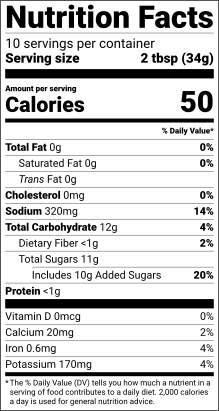
The BBQ sauce’s US Nutrition Facts panel, drawn by the maker from the rows above.
Note the fat: 0.1052 g per serving prints as 0g, and its %DV is worked out from the 0 that is printed, so it shows 0%. The dietary fiber and protein fall between 0.5 and 1 g and print as “<1g”. To check your own product the same way, use the US label with FDA rounding.
Canada's rounding rules
Canada’s increments are in column 4 of the tables to sections B.01.401 and B.01.402 of the Food and Drug Regulations. They look like the US bands, with one big difference: small amounts become 0 only when the food meets a “free of” condition (checked per reference amount and per serving); otherwise they are printed in small steps. Potassium and calcium step up in 10 mg, 25 mg, 50 mg increments, and the %DV comes from the rounded amounts.
| Nutrient | Amount and rounding | Source |
|---|---|---|
| Calories | Less than 5 Calories: nearest 1 Calorie 5 to 50 Calories: nearest 5 Calories More than 50 Calories: nearest 10 Calories Below 5 Calories: 0 when the food is “free of energy” (less than 5 Calories per reference amount and per serving). | table to B.01.401 item 2 column 4 |
| Fat | Less than 0.5 g: nearest 0.1 g 0.5 to 5 g: nearest 0.5 g More than 5 g: nearest 1 g Below 0.5 g: “0 g” when the food is “free of fat” (less than 0.5 g) and saturated and trans fat are declared 0 g. | table to B.01.401 item 3 column 4 |
| Saturated fat and trans fat | Less than 0.5 g: nearest 0.1 g 0.5 to 5 g: nearest 0.5 g More than 5 g: nearest 1 g Below 0.5 g: “0 g” when the food is “free of” that fat (saturated: less than 0.2 g saturated and 0.2 g trans; trans: less than 0.2 g trans and low in saturated fat). | table to B.01.401 items 4-5 column 4 |
| Cholesterol | Any amount: nearest 5 mg “0 mg” when the food is “free of cholesterol” (less than 2 mg and low in saturated fat). | table to B.01.401 item 7 column 4 |
| Sodium | Less than 5 mg: nearest 1 mg 5 to 140 mg: nearest 5 mg More than 140 mg: nearest 10 mg Below 5 mg: “0 mg” when the food is “free of sodium” (less than 5 mg). | table to B.01.401 item 8 column 4 |
| Carbohydrate, fibre, soluble fibre, insoluble fibre, sugars, sugar alcohols and starch | Less than 0.5 g: print 0 g 0.5 g or more: nearest 1 g | table to B.01.401 items 9-11 column 4; table to B.01.402 items 10-13 |
| Protein | Less than 0.5 g: nearest 0.1 g 0.5 g or more: nearest 1 g | table to B.01.401 item 12 column 4 |
| Potassium, calcium, phosphorus and chloride | Less than 5 mg: print 0 mg 5 mg to less than 50 mg: nearest 10 mg 50 mg to less than 250 mg: nearest 25 mg 250 mg or more: nearest 50 mg | table to B.01.401 items 13-14 column 4; table to B.01.402 items 28, 37 |
| Iron, vitamin E, vitamin K, niacin, biotin, zinc, chromium and molybdenum | Less than 0.05: print 0 0.05 to less than 0.5: nearest 0.1 0.5 to less than 2.5: nearest 0.25 2.5 or more: nearest 0.5 In the unit each one is declared in (mg or µg). | table to B.01.401 item 15 column 4; table to B.01.402 items 17, 18, 21, 25, 31, 35, 36 |
| % Daily Value | Any amount: nearest 1% From the declared (rounded) amount; “0 %” when the amount is declared 0. Saturated and trans fat share one %DV. | table to B.01.401 column 4 subitem (2); table to B.01.402 items 14-37 subitem (2) |
| Serving size in grams or millilitres | Less than 10 g: nearest 0.1 g 10 g or more: nearest 1 g | table to B.01.401 item 1 column 4 |
More nutrients, when you declare them:
| Nutrient | Amount and rounding | Source |
|---|---|---|
| Polyunsaturated, omega-6, omega-3 and monounsaturated | Less than 1 g: nearest 0.1 g 1 to 5 g: nearest 0.5 g More than 5 g: nearest 1 g | table to B.01.402 items 5-8 column 4 |
| Vitamin A | Less than 5 µg: print 0 µg 5 µg to less than 50 µg: nearest 10 µg 50 µg to less than 250 µg: nearest 50 µg 250 µg or more: nearest 100 µg | table to B.01.402 item 14 column 4 |
| Vitamin C, vitamin D and selenium | Less than 0.1: print 0 0.1 to less than 1: nearest 0.2 1 to less than 5: nearest 0.5 5 or more: nearest 1 | table to B.01.402 items 15, 16, 32 column 4 |
| Thiamine, riboflavin, vitamin B6, vitamin B12 and manganese | Less than 0.005: print 0 0.005 to less than 0.05: nearest 0.01 0.05 to less than 0.25: nearest 0.025 0.25 or more: nearest 0.05 | table to B.01.402 items 19, 20, 22, 24, 34 column 4 |
| Folate, choline, iodide and magnesium | Less than 1: print 0 1 to less than 10: nearest 2 10 to less than 50: nearest 5 50 or more: nearest 10 | table to B.01.402 items 23, 27, 29, 30 column 4 |
| Pantothenate | Less than 0.01 mg: print 0 mg 0.01 mg to less than 0.1 mg: nearest 0.02 mg 0.1 mg to less than 0.5 mg: nearest 0.05 mg 0.5 mg or more: nearest 0.1 mg | table to B.01.402 item 26 column 4 |
| Copper | Less than 0.0015 mg: print 0 mg 0.0015 mg to less than 0.025 mg: nearest 0.002 mg 0.025 mg to less than 0.05 mg: nearest 0.005 mg 0.05 mg or more: nearest 0.01 mg | table to B.01.402 item 33 column 4 |
| Kilojoules (optional) | Any amount: nearest 10 kJ | table to B.01.402 item 2 column 4 |
| Nutrient | Unrounded per serving | On the label |
|---|---|---|
| Fat | 0.43 g | 0.4 g |
| Fat | 4.74 g | 4.5 g |
| Sodium | 137.5 mg | 140 mg |
| Carbohydrate, sugars, fibre | 0.49 g | 0 g |
| Carbohydrate, sugars, fibre | 0.5 g | 1 g |
| Potassium, calcium | 221.1 mg | 225 mg |
| Iron | 2.009 mg | 2 mg |
The bilingual table prints the French amounts with a decimal comma (“4,5 g”). The Canadian rounding applied page shows the full table format.
EU and UK: rounding guidance
Regulation (EU) No 1169/2011 doesn’t set increments. The rounding comes from the European Commission’s 2012 guidance on tolerances for nutrient values, which includes a rounding table; the UK’s nutrition labeling guidance uses the same table for Great Britain, and Northern Ireland follows the EU. Values are per 100 g or 100 ml (and per portion when you add one); halfway values round up (0.5 → 1).
| Nutrient | Amount and rounding | Source |
|---|---|---|
| Energy (kJ and kcal) | Any amount: nearest 1 kJ / kcal kJ and kcal are each worked out from the nutrients with the legal factors, then rounded. | s.6 Table 4 (energy) |
| Fat, carbohydrate, sugars, polyols, starch, fibre and protein | Less than 0.5 g: print “less than 0.5 g” 0.5 g to less than 10 g: nearest 0.1 g 10 g or more: nearest 1 g A true zero prints “0 g”. A value that rounds into the next band takes that band’s rounding (9.96 g → “10 g”). | s.6 Table 4 (fat, carbohydrate, sugars, protein, fibre, polyols, starch) |
| Saturates, mono-unsaturates and polyunsaturates | Less than 0.1 g: print “less than 0.1 g” 0.1 g to less than 10 g: nearest 0.1 g 10 g or more: nearest 1 g | s.6 Table 4 (saturates, mono-unsaturates, polyunsaturates) |
| Salt | Less than 0.0125 g: print “less than 0.01 g” 0.0125 g to less than 1 g: nearest 0.01 g 1 g or more: nearest 0.1 g | s.6 Table 4 (salt) |
| Vitamin A, folic acid, potassium, chloride, calcium, phosphorus, magnesium and iodine | Any amount: 3 significant figures | s.6 Table 4 (vitamins and minerals, 3 s.f.) |
| Other vitamins and minerals | Any amount: 2 significant figures | s.6 Table 4 (vitamins and minerals, 2 s.f.) |
| % Reference intake | Any amount: nearest 1% UK guidance; amounts below 1% of the reference intake may be shown as “<1%”. | Annex 2 Step 2.1 |
For very small amounts the guidance allows either “0 g” or a “less than” figure. The maker prints “0 g” for a true zero and “<0.5 g” (or “<0.1 g”, “<0.01 g” for salt) for a small amount that isn’t zero. At the edges:
| Row | Unrounded per 100 g | On the label |
|---|---|---|
| Fat, carbohydrate, sugars, protein | 0.45 g | <0.5 g |
| Fat, carbohydrate, sugars, protein | 6.45 g | 6.5 g |
| Fat, carbohydrate, sugars, protein | 9.96 g | 10 g |
| Fat, carbohydrate, sugars, protein | 10.54 g | 11 g |
| Saturates | 0.08 g | <0.1 g |
| Saturates | 1.984 g | 2.0 g |
| Salt | 0.01 g | <0.01 g |
| Salt | 0.367 g | 0.37 g |
| Salt | 1.04 g | 1.0 g |
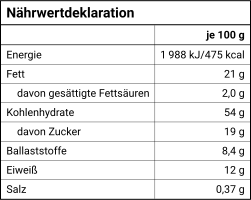
The granola’s German label: the same rounding, with German row names and a decimal comma.
Australia and New Zealand: 3 significant figures
Standard 1.2.8 of the Food Standards Code says the values in a Nutrition Information Panel are written with no more than three significant figures. FSANZ’s own Nutrition Panel Calculator adds a decimal-place convention for amounts under 100, which the maker follows; halfway values round to the even digit (0.25 → 0.2, 0.35 → 0.4).
| Nutrient | Amount and rounding | Source |
|---|---|---|
| Energy | Less than 100 kJ: nearest 1 kJ 100 kJ or more: 3 significant figures May be printed as “LESS THAN 40 kJ” when a serving has less than 40 kJ. | 1.2.8—7(3) (not more than 3 significant figures); FG3 decimal-place convention; FG3/FG4 §3.6 ties to even |
| Protein, fat, saturated fat, carbohydrate, sugars and dietary fibre (and the other rows in grams) | Less than 100 g: 1 decimal place 100 g or more: 3 significant figures Protein, fat, fatty acids, carbohydrate, sugars and dietary fibre may be printed as “LESS THAN 1 g” below 1 g. | 1.2.8—7(3) (not more than 3 significant figures); FG3 decimal-place convention; FG3/FG4 §3.6 ties to even |
| Sodium and potassium | Less than 100 mg: nearest 1 mg 100 mg or more: 3 significant figures May be printed as “LESS THAN 5 mg” below 5 mg. | 1.2.8—7(3) (not more than 3 significant figures); FG3 decimal-place convention; FG3/FG4 §3.6 ties to even |
| Vitamins, minerals, cholesterol and other substances | Any amount: 3 significant figures | 1.2.8—7(3) (not more than 3 significant figures); FG3 decimal-place convention; FG3/FG4 §3.6 ties to even |
| %DI and %RDI | Any amount: nearest 1% | §4.2 example (14.28 → 14%); house: ties to even |
| Unrounded | Rule | On the panel |
|---|---|---|
| 1,142 kJ | 3 significant figures | 1,140 kJ |
| 1,145 kJ | 3 significant figures | 1,140 kJ |
| 2,034.6 kJ | 3 significant figures | 2,030 kJ |
| 5.24 g | 1 decimal place | 5.2 g |
| 0.26 g | 1 decimal place | 0.3 g |
| 123.45 g | 3 significant figures | 123 g |
| 17.5 mg | Nearest 1 mg | 18 mg |
| 2,666.7 mg | 3 significant figures | 2,670 mg |
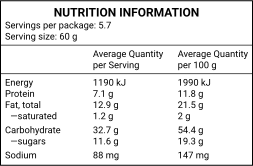
The granola’s Nutrition Information Panel: per serving and per 100 g, three significant figures at most.
The NIP with 3 significant figures page covers the rest of the panel: %DI, the “LESS THAN” forms and the columns.
Round once, at the end
Keep every value unrounded until the last step, and round it on the basis the label shows. Rounding twice, for example rounding per 100 g first and then scaling to a serving, moves values across band edges.
| Granola, total sugars | Steps | On the US label |
|---|---|---|
| Rounded once (right) | 19.26 g per 100 g × 0.6 = 11.56 g, rounded | 12g |
| Rounded twice (wrong) | 19.26 g rounded to 19 g, × 0.6 = 11.4 g, rounded again | 11g |
The same goes for recipes: add the ingredients up unrounded, divide by the finished weight, and round only what you print. The %DV is a separate question. US rules let you calculate it from the declared amount or the actual one, as long as you do it the same way across the label; the maker uses the declared amount, as FDA’s own sample labels do. To see all six steps of a label together, read how to make a nutrition label, or open the maker and let it round for you.