The short answer
Nutrient per 100 g = (sum of grams × value per 100 g ÷ 100) ÷ finished weight × 100.
- Weigh every ingredient in grams.
- Match each one to good nutrient data.
- Add up the whole batch.
- Weigh the finished batch.
- Work out per 100 g and per serving.
- Round once, with your market’s rules.
Below, each step is shown on a real recipe: our honey almond granola, calculated with USDA FoodData Central data exactly as the recipe nutrition label maker does it.
Step 1: Weigh every ingredient in grams
Nutrient data is stated per 100 grams, so grams are the only unit that goes straight into the sum. Cups and spoons measure volume, and a cup of one ingredient weighs very differently from a cup of another, or even of the same ingredient packed differently. These are the USDA’s own weights for one cup of the granola’s ingredients:
| Ingredient | Measure | Weight (USDA) |
|---|---|---|
| Whole grain rolled oats | 1 cup | 81 g |
| Almonds | 1 cup, whole | 143 g |
| Almonds | 1 cup, sliced | 92 g |
| Honey | 1 cup | 339 g |
| Brown sugar | 1 cup packed | 220 g |
| Brown sugar | 1 cup unpacked | 145 g |
| Canola oil | 1 cup | 218 g |
So weigh in grams whenever you can. When you can only use a household measure, use that ingredient’s own portion weight. The maker converts cups and spoons with the weight the USDA gives for that ingredient and that measure, never with one universal density.
Step 2: Match each ingredient to good data
- USDA FoodData Central is the usual free source: the maker ships its SR Legacy and Foundation Foods data (public
domain, CC0), and records the data version with your recipe. This example used version
fdc-sr2018-fd2026-10-45d04d4eeb. - Raw or cooked? Pick the record for the form you weighed. If you weighed raw rolled oats, use the raw oats record; the water lost in baking is handled by the finished weight in step 4.
- Branded or unusual ingredients (a chocolate chip, a spice blend, a flavored syrup) are better taken from your supplier’s specification. The maker lets you add them as custom ingredients.
- Added sugars come from the sweeteners you add. In this recipe, the sugars of honey, brown sugar and vanilla extract count as added; the small amount of sugar naturally in oats and almonds does not.
Step 3: Add up the whole batch
For each ingredient, multiply its value per 100 g by its weight and divide by 100. Then add up each column. This is the granola’s batch, line by line:
| Ingredient | Weight | Calories | Fat | Sugars | Protein | Sodium |
|---|---|---|---|---|---|---|
| Whole grain rolled oats | 500 g | 1,895 | 32.6 g | 5 g | 65.8 g | 30 mg |
| Almonds | 150 g | 868.5 | 74.9 g | 6.5 g | 31.7 g | 1.5 mg |
| Honey | 120 g | 364.8 | 0 g | 98.5 g | 0.4 g | 4.8 mg |
| Brown sugar | 50 g | 190 | 0 g | 48.5 g | 0.1 g | 14 mg |
| Canola oil | 70 g | 618.8 | 70 g | 0 g | 0 g | 0 mg |
| Sea salt | 3 g | 0 | 0 g | 0 g | 0 g | 1,162.8 mg |
| Vanilla extract | 6 g | 17.3 | 0 g | 0.8 g | 0 g | 0.5 mg |
| Whole batch | 899 g | 3,954.4 | 177.5 g | 159.3 g | 97.9 g | 1,213.6 mg |
Values per line = weight × the ingredient’s USDA value per 100 g ÷ 100, shown to one decimal place; the totals and everything after them are calculated unrounded.
Step 4: Weigh the finished batch (recipe yield)
Recipe yield is the amount of finished food a recipe makes, weighed after cooking. Baking, roasting and simmering drive off water; the nutrients stay behind, so every gram of the finished food carries more of them than a gram of the raw mix.
The granola went into the oven as 899 g of mix and came out as 827 g: a yield of 92%. If you divided by the raw weight instead, every value on the label would come out about 8% too low. Weigh the whole batch when it has cooled, before you portion it.
Step 5: Per 100 g and per serving
Divide each batch total by the finished weight and multiply by 100. For calories:
3,954.4 ÷ 827 g × 100 = 478.2 Calories per 100 g
478.2 × 60 ÷ 100 = 286.9 Calories per serving (1 cup (60 g))
And for total sugars: 159.3 g ÷ 827 × 100 = 19.26 g per 100 g, or 11.56 g per serving, of which 10.72 g are added sugars. Keep these numbers unrounded: the UK and EU print per 100 g, the US and Canada per serving, and Australia and New Zealand both.
Step 6: Round for your market
Rounding happens once, at the end, to the value on the label’s own basis. Round the per-100 g values first and then scale them to a serving, and the errors add up: the label can end up a gram or more away from the true value. The US label rounds the 286.9 Calories per serving to 290; the UK label prints energy per 100 g as 1988 kJ/475 kcal, worked out from fat, carbohydrate, fiber and protein with the UK’s energy factors. Each market’s increments are in our guide to rounding rules.
Worked example: honey almond granola
The full result for the granola: 899 g of ingredients baked to 827 g, served as 1 cup (60 g).
| Nutrient | Whole batch | Per 100 g | Per serving (60 g) | US label |
|---|---|---|---|---|
| Calories | 3,954 kcal | 478.2 kcal | 286.9 kcal | 290 |
| Total fat | 177.5 g | 21.46 g | 12.88 g | 13g |
| Saturated fat | 16.41 g | 1.984 g | 1.191 g | 1g |
| Sodium | 1,214 mg | 146.8 mg | 88.05 mg | 90mg |
| Total carbohydrate | 519.5 g | 62.82 g | 37.69 g | 38g |
| Dietary fiber | 69.49 g | 8.403 g | 5.042 g | 5g |
| Total sugars | 159.3 g | 19.26 g | 11.56 g | 12g |
| Added sugars | 147.8 g | 17.87 g | 10.72 g | 11g |
| Protein | 97.9 g | 11.84 g | 7.103 g | 7g |
The same product, drawn as a US Nutrition Facts panel and a UK nutrition table:
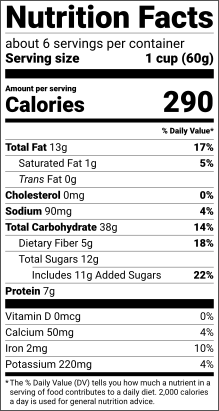
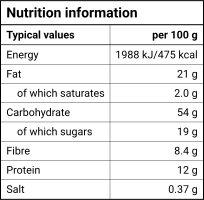
Both panels come from the same recipe calculation. The UK table shows per 100 g, with energy in kJ and kcal and salt instead of sodium.
How far to trust a recipe calculation
To do this for your own recipe, open the maker in recipe mode: search each ingredient, enter its weight, add the finished weight, and choose the markets you sell in.
When to use a lab instead
A calculation assumes the nutrients in the ingredients end up in the food. Use a lab analysis when that isn’t true, or when the stakes are higher:
- Frying: food takes up an unknown amount of the frying oil.
- Fermentation: yeasts and bacteria use up sugars and make other compounds.
- Long cooking or draining: vitamins break down, and fat or salt can be poured off with the liquid.
- Nutrition or health claims (“high in fiber”, “low sodium”): the claim has to hold for the real product.
- Large volumes or retail buyers that ask for an analysis certificate.
For an unusual process or a product with claims, ask a food-labeling specialist to look at your method as well as your label. The steps to finish the label itself are in how to make a nutrition label.