Nutrition label requirements
by country
See how the US, UK, EU, Canada, Australia and New Zealand differ before you make a label for a new market, then open the maker with that market selected.
How six markets' nutrition labels differ.
-
Nutrition Facts label
-
Nutrition declaration (often titled “Nutrition information”)
-
Nutrition declaration, in the language of the country
-
Nutrition Facts table, in English and French
-
Nutrition information panel (NIP)
-
Nutrition information panel (NIP)
The six markets at a glance
One product, the Honey Almond Granola sample, made into each market’s label by the maker. The grey boxes are the text exactly as the engine prints it on that label; everything else is the rule behind it. The UK column is Great Britain; Northern Ireland follows the EU rules, in English.
| Rule | United States | Canada | United Kingdom | European Union | Australia | New Zealand |
|---|---|---|---|---|---|---|
| What the panel is called | Nutrition Facts label Nutrition Facts | Nutrition Facts table, in English and French Nutrition Facts / Valeur nutritive | Nutrition declaration (often titled “Nutrition information”) Nutrition information | Nutrition declaration, in the language of the country Nährwertdeklaration | Nutrition information panel (NIP) NUTRITION INFORMATION | Nutrition information panel (NIP) NUTRITION INFORMATION |
| Main rule the maker follows | 21 CFR 101.9 (FDA) | Food and Drug Regulations, Part B.01 | Regulation (EU) No 1169/2011, kept as Great Britain’s own (assimilated) law | Regulation (EU) No 1169/2011 | Food Standards Code, Standard 1.2.8 and Schedules 11–12 | Food Standards Code, Standard 1.2.8 and Schedules 11–12 (through the Food Act 2014) |
| Values are given | Per serving (a regulated reference amount, in household measures), plus per container when required Serving size 1 cup (60g) | Per serving of stated size, based on Canada’s reference amounts Per 1 cup (60 g) | Per 100 g or 100 ml; per portion only as an extra per 100 g | Per 100 g or 100 ml; per portion only as an extra je 100 g | Per serving (your choice of size) and per 100 g or 100 mL, side by side Average Quantity per Serving | Average Quantity per 100 g | Per serving (your choice of size) and per 100 g or 100 mL, side by side Average Quantity per Serving | Average Quantity per 100 g |
| Energy | Calories (kcal) only Calories 290 | Calories (kcal); kJ optional Calories 290 | kJ and kcal, each worked out from the components Energy 1988 kJ/475 kcal | kJ and kcal, each worked out from the components Energie 1 988 kJ/475 kcal | Kilojoules, worked out from the components; kcal optional (kJ ÷ 4.18) Energy 1190 kJ | 1990 kJ | Kilojoules, worked out from the components; kcal optional (kJ ÷ 4.18) Energy 1190 kJ | 1990 kJ |
| Carbohydrate | Total carbohydrate, fiber included Total Carbohydrate 38g | Total carbohydrate, fibre included Carbohydrate 38 g | Available carbohydrate: fibre left out (sugar alcohols stay in) Carbohydrate 54 g | Available carbohydrate: fibre left out (sugar alcohols stay in) Kohlenhydrate 54 g | Available carbohydrate: fibre and sugar alcohols left out Carbohydrate 32.7 g | 54.4 g | Available carbohydrate: fibre and sugar alcohols left out Carbohydrate 32.7 g | 54.4 g |
| Sodium or salt | Sodium in mg Sodium 90mg | Sodium in mg Sodium 90 mg | Salt in g (sodium × 2.5) Salt 0.37 g | Salt in g (sodium × 2.5) Salz 0,37 g | Sodium in mg Sodium 88 mg | 147 mg | Sodium in mg Sodium 88 mg | 147 mg |
| Nutrients that must be listed | 15 rows Calories · Total Fat · Saturated Fat · Trans Fat · Cholesterol · Sodium · Total Carbohydrate · Dietary Fiber · Total Sugars · Added Sugars · Protein · Vitamin D · Calcium · Iron · Potassium | 13 rows Calories · Fat · Saturated · Trans · Carbohydrate · Fibre · Sugars · Protein · Cholesterol · Sodium · Potassium · Calcium · Iron | 7 rows Energy · Fat · of which saturates · Carbohydrate · of which sugars · Protein · Salt | 7 rows Energie · Fett · davon gesättigte Fettsäuren · Kohlenhydrate · davon Zucker · Eiweiß · Salz | 7 rows Energy · Protein · Fat, total · saturated · Carbohydrate · sugars · Sodium | 7 rows Energy · Protein · Fat, total · saturated · Carbohydrate · sugars · Sodium |
| Percentages | % Daily Value, required % Daily Value* | % Daily Value, required (including sugars) % Daily Value* / % valeur quotidienne* | % Reference intake (%RI), optional | % Reference intake (%RI), optional | % Daily intake, optional | % Daily intake, optional |
| Label language | English | English and French | English (Northern Ireland: English, under EU rules) | The language(s) of the country you sell in; the maker prints all 24 official EU languages | English | English (an origin statement may be in Māori) |
| Front of pack | Nothing required. FDA’s front-of-package proposal is not final, so the maker doesn’t use it. | The “High in” symbol is mandatory for foods over the thresholds (since 1 January 2026). The maker checks it and adds Health Canada’s official symbol. Granola: no symbol needed | Traffic lights are voluntary; the maker can add them (Great Britain only) | No EU-wide scheme. National schemes such as Nutri-Score are voluntary; the maker doesn’t make them. | Health Star Rating is voluntary; the maker doesn’t calculate it. | Health Star Rating is voluntary; the maker doesn’t calculate it. |
| Allergens | Nine major food allergens: a “Contains:” statement after the ingredients Contains: Almonds. | Priority food allergens, gluten sources and added sulphites: a “Contains:” statement in English and French Contains: Oats, Almonds | 14 allergens (Annex II): emphasised in the ingredient list; no separate “Contains” list Emphasised in the list: oats, Almonds | 14 allergens (Annex II): emphasised in the ingredient list, in the label language; no separate “Contains” list Emphasised in the list: Hafer, Mandeln | Plain English Allergen Labelling (PEAL): bold in the ingredient list plus a bold “Contains” summary Contains gluten, almond | Plain English Allergen Labelling (PEAL): bold in the ingredient list plus a bold “Contains” summary Contains gluten, almond |
| Numbers | FDA rounding steps per nutrient; no space before g 13g | Canadian rounding steps; a space before g and % 13 g, 17 % | EU rounding guidance; decimal point 2.0 g | EU rounding guidance; the decimal mark of the language (a comma in German) 2,0 g | At most 3 significant figures 1990 kJ, 1.2 g | At most 3 significant figures 1990 kJ, 1.2 g |
In short: the US and Canada label per serving in Calories with % Daily Values; the UK and EU label per 100 g or 100 ml in kJ and kcal with salt; Australia and New Zealand show per serving and per 100 g side by side in kilojoules with sodium. Only Canada requires a front-of-package symbol, and only the EU asks for the language of the country you sell in.
Why you can't just relabel
A label for another country is not a translated template. The numbers themselves change, because four things differ:
- Serving rules. The US and Canada fix the serving from reference amounts: the granola’s US serving is 1 cup (60g). Australia and New Zealand let you choose it, and the UK and EU start from 100 g.
- Nutrient definitions. “Carbohydrate” is Total Carbohydrate 38g on the US label, Carbohydrate 54 g per 100 g in the UK and Carbohydrate 32.7 g per serving in Australia: total carbohydrate in North America, fibre left out in Europe, fibre and sugar alcohols left out in Australia and New Zealand.
- Energy and rounding. Calories 290 per serving in the US, Energy 1988 kJ/475 kcal per 100 g in the UK, and Energy 1190 kJ per serving in Australia, each worked out and rounded the market’s own way.
- Language and layout. English and French in Canada, the country’s language in the EU, and a different panel shape everywhere.
Here is that granola as the engine draws it for each of the seven rule sets:
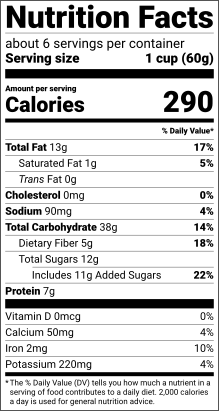
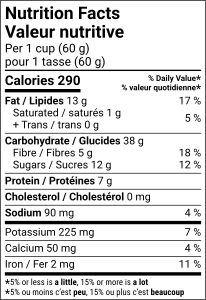
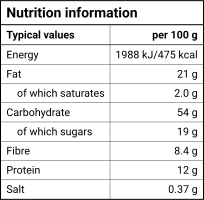
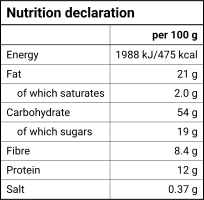
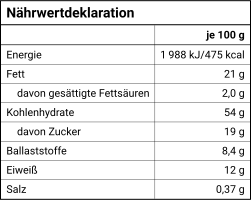
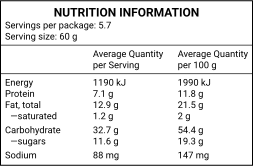
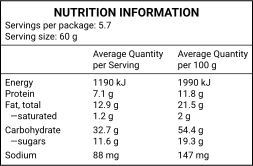
One product, seven labels, all drawn by the engine from the same recipe data. Every one is Ready for the supported output.
What converts automatically, and what we ask for
The maker converts only what can be converted safely, records each conversion on the label’s check list, and works from unrounded values:
| Conversion | How | What it needs from you | When it’s used |
|---|---|---|---|
| Sodium ↔ salt | salt = sodium × 2.5, on the same basis, from the unrounded value | Nothing extra | UK and EU labels show salt; the US, Canada, Australia and New Zealand show sodium |
| Per serving ↔ per 100 g | multiply or divide by the serving weight, before rounding | The serving size in grams | All six markets |
| Per 100 g ↔ per 100 ml | multiply or divide by the product’s density | The density (g per ml) of your product; never a standard figure | Liquids in the UK, EU, Australia and New Zealand |
| Energy from fat, carbohydrate, protein and fibre | each market’s own energy factors, from the unrounded components | Every component, fibre included (0 g if there is none) | Always in the UK, EU, Australia and New Zealand; in Canada when Calories are missing |
| kcal ↔ kJ | only where the rule gives a factor: Canada × 4.184, Australia and New Zealand ÷ 4.18 | Nothing extra | Canada (optional kJ), Australia and New Zealand (optional kcal). The EU works out kJ and kcal separately instead. |
| Total → available carbohydrate | total carbohydrate − fibre (Australia and New Zealand also − sugar alcohols) | Dietary fibre; sugar alcohols for Australia and New Zealand (0 g if none) | A US or Canadian label going to the UK, EU, Australia or New Zealand |
Everything else is Additional information needed: the maker asks instead of filling a gap with zero. For example, copy the granola’s UK label (energy 1988 kJ/475 kcal, fat 21 g, of which saturates 2.0 g, carbohydrate 54 g, of which sugars 19 g, fibre 8.4 g, protein 12 g, salt 0.37 g per 100 g) and ask for the other markets:
| Market | Result | What the maker asks for |
|---|---|---|
| United States | Needs values | 7 more values: trans fat, cholesterol, added sugars, vitamin D, calcium, iron and potassium. |
| Canada | Needs values | 5 more values: trans fat, cholesterol, potassium, calcium and iron. Some values (total fat, saturated fat, dietary fiber, total sugars, protein) were copied from a printed label, so they are already rounded. |
| France (EU) | Ready for the supported output | Nothing more. |
| Australia | Needs review | Nothing more. Some values were copied from a printed label, so they are already rounded (energy, protein, total fat, saturated fat…). |
| New Zealand | Needs review | Nothing more. Some values were copied from a printed label, so they are already rounded (energy, protein, total fat, saturated fat…). |
Added sugars are the clearest case: they can’t be worked out from total sugars, so a US label needs your figure. A copied label’s numbers are already rounded, so markets that recalculate from them say “Needs review”.
Choose your market
-
United States
Nutrition Facts label
FDA Nutrition Facts panels: standard, dual column, tabular and linear formats, built from 21 CFR 101.9.
Per serving (a regulated reference amount, in household measures), plus per container when required.
-
United Kingdom
Nutrition declaration (often titled “Nutrition information”)
Nutrition declarations per 100 g or 100 ml for Great Britain and for Northern Ireland, with salt and kJ/kcal.
Per 100 g or 100 ml; per portion only as an extra.
-
European Union
Nutrition declaration, in the language of the country
EU nutrition declarations in the language of the member state you sell in, in the Regulation 1169/2011 order.
Per 100 g or 100 ml; per portion only as an extra.
-
Canada
Nutrition Facts table, in English and French
Bilingual Nutrition Facts / Valeur nutritive tables and a front-of-pack "High in" check.
Per serving of stated size, based on Canada’s reference amounts.
-
Australia
Nutrition information panel (NIP)
Nutrition Information Panels per serving and per 100 g or 100 ml, built from FSANZ Standard 1.2.8.
Per serving (your choice of size) and per 100 g or 100 mL, side by side.
-
New Zealand
Nutrition information panel (NIP)
Nutrition Information Panels for New Zealand, with the New Zealand rules where they differ from Australia.
Per serving (your choice of size) and per 100 g or 100 mL, side by side.
Northern Ireland: under the Windsor Framework it keeps the EU rules (Regulation (EU) No 1169/2011), in English, while Great Britain applies the same Regulation as its own law, which can now change separately. The maker treats them as two markets under the UK; see the UK nutrition label generator. To start with all six markets at once, open the nutritional label maker.
Frequently asked questions
Can I use a US nutrition label in the UK or EU?
Which countries use per 100 g nutrition labels?
Do Canada and the US use the same Nutrition Facts label?
Is the UK still following EU labelling rules?
Make the label for your next market
Choose your markets, add your values or recipe, and see what each one still needs. No sign-up to build.
Create a nutrition label