New Zealand nutrition information panel calculator
New Zealand uses the same Food Standards Code NIP as Australia, with its own enforcement, origin rules and food data. Enter values or a recipe and download a NIP sized for your pack.
NIPs for New Zealand, per serving and per 100 g.
Single-ingredient sugars: the maker asks you to check the “†” added-sugars statement.
No “High in” symbol needed on the front of pack The product is a sweetening agent sold as such (sugar, honey, maple syrup, agave, molasses …).
-
The joint Code’s NIP
The same NUTRITION INFORMATION panel as Australia: per serving and per 100 g, at most 3 significant figures.
-
Energy from Schedule 11
kJ worked out from protein, fat, carbohydrate and fibre. kcal and %DI when you want them.
-
Plain English allergens
Required names in bold in the ingredient list, plus the bold “Contains” summary.
-
Exact-size files
PDF, SVG and PNG at your jar’s size, and the Australian label from the same product.
How it works
-
Step 1: Choose New Zealand
Add Australia as well if you export: one product, two labels, each checked against its own rules.
-
Step 2: Add your numbers
Values per 100 g or per serving, a recipe from USDA ingredient data, or the numbers from an existing panel.
-
Step 3: Check and download
The maker works out both columns and the allergen text. No sign-up to build. Free account to download.
On this page 10 sections
Same panel as Australia, different rules around it
New Zealand and Australia share one Food Standards Code. In New Zealand it applies through the Food Act 2014, so Standard 1.2.8 and Schedules 11 and 12 give exactly the same nutrition information panel (NIP), and the allergen and ingredient rules are the same too. What changes is the law around the panel:
| Topic | New Zealand | Australia |
|---|---|---|
| Nutrition panel, allergens, ingredients | Food Standards Code (through the Food Act 2014) | The same Code |
| Country of origin | Origin of Food Regulations 2021: only some fresh and frozen foods and cured pork; plain text in English or Māori; enforced by the Commerce Commission | Country of Origin Food Labelling Information Standard 2016: most packaged food; kangaroo mark and bar chart; enforced by the ACCC |
| Net quantity | Weights and Measures Regulations 1999: at least 2 mm high whatever the pack size, one unit only | Trade measurement regulations: minimum heights from 2.0 to 4.8 mm by pack size |
| Supplier address | A New Zealand or Australian address | An Australian or New Zealand address |
| Special categories | Supplemented foods follow a separate New Zealand regime (not supported here) | Not applicable |
The maker keeps them as two markets, so one product gets a New Zealand label and an Australian label, each checked against its own rules.
What a New Zealand NIP must show
The same rows as in Australia: servings per package and serving size, then energy, protein, fat (total and saturated), carbohydrate (total and sugars) and sodium — 7 rows printed as “Energy”, “Protein”, “Fat, total”, “—saturated”, “Carbohydrate”, “—sugars”, “Sodium” — as average quantities per serving and per 100 g (or 100 mL). Energy is in kilojoules; kcal is optional. Rows for fibre, other fats or vitamins appear only with a claim. Here is the sample clover honey, Ready for New Zealand, with and without the optional kcal:
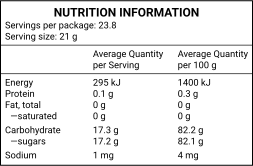
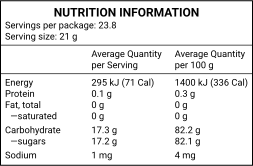
The clover honey NIP drawn by the engine for New Zealand, and the same panel with kcal (printed as “kJ (Cal)”).
Every rule behind the panel is explained on the Australian nutrition information panel page; it applies here unchanged.
Worked example: clover honey
A 500 g jar with a 21 g serving (one tablespoon) gives Servings per package: 23.8. Carbohydrate is total carbohydrate 82.4 g − fibre 0.2 g − sugar alcohols 0 g = 82.2 g per 100 g. Energy is the Schedule 11 calculation, not the figure in the ingredient data; the maker’s note on the sample reads: “Energy is worked out from the components with the Schedule 11 factors: 1404 kJ per 100 g. The 1272 kJ you entered is not used.”
| Row | Per 100 g, unrounded | Printed | Per 21 g, unrounded | Printed |
|---|---|---|---|---|
| Energy | 1404.1 kJ | 1400 kJ | 294.861 kJ | 295 kJ |
| Protein | 0.3 g | 0.3 g | 0.063 g | 0.1 g |
| Fat, total | 0 g | 0 g | 0 g | 0 g |
| —saturated | 0 g | 0 g | 0 g | 0 g |
| Carbohydrate | 82.2 g | 82.2 g | 17.262 g | 17.3 g |
| —sugars | 82.12 g | 82.1 g | 17.2452 g | 17.2 g |
| Sodium | 4 mg | 4 mg | 0.84 mg | 1 mg |
Honey is almost all sugar, so look at the small rows. Protein is 0.063 g per serving: below 100, grams keep one decimal place, so it prints as 0.1 g. Fat is a true zero and prints as 0 g. Sodium is 0.84 mg per serving and prints as the whole number 1 mg. If a value isn’t zero but would round to zero, the Code lets you write “LESS THAN 1 g” or “LESS THAN 5 mg” instead, and the maker does.
Allergens in plain English
Plain English Allergen Labelling (PEAL) applies in New Zealand exactly as in Australia: the required names in bold in the ingredient list, and a bold summary statement starting with “Contains”. The honey has none of the listed allergens, so its label has a one-line ingredient list and no summary:
Clover honeyIngredients: Clover honey.
The sample toasted muesli, labeled for New Zealand, shows both parts:
Toasted muesliIngredients: Rolled oats, Raisins, Almonds, Honey, Wheat bran, Sunflower seeds, Canola oil.
Contains gluten, almond, wheat
Barley, oats and rye appear as “gluten” in the summary, and wheat as wheat and gluten. More on the list itself: plain English allergen text.
Country of origin in New Zealand
The Consumer Information Standards (Origin of Food) Regulations 2021 cover far fewer foods than Australia’s scheme. Only a regulated food needs an origin statement: one type of fruit, vegetable, meat, finfish or shellfish that is fresh, thawed or frozen and no more than minimally processed (cut, minced, filleted, peeled, washed), or cured pork such as bacon and ham. Processed foods, mixes, dried, canned or cooked foods are not covered. The regulations apply to retail sale; frozen foods have been covered since 12 May 2023.
What you disclose depends on the food: where fruit and vegetables were grown, where the animals were raised (for cured pork too, not where it was cured), and where fish were caught or shellfish harvested. The words are yours, in English or Māori, as long as they link the food to a country or one of the five named oceans. A region on its own (“Hawke’s Bay”), “EU”, a flag or a map is not enough. There is no mark, box or minimum size.
The engine’s New Zealand origin module, on 8 products (5 of them covered):
| Product | Facts | Statement | Result |
|---|---|---|---|
| Clover honey (the sample) | Honey | Not covered | It is not fresh fruit, vegetables, meat or seafood, or cured pork. |
| Fresh apples | One type of fruit, fresh, grown in New Zealand | Product of New Zealand Also fine: Grown in New Zealand; New Zealand Apples | Clear text with the item; no mark, logo, box or minimum size. |
| Frozen peas | One type of vegetable, frozen, grown in Belgium | Product of Belgium Also fine: Grown in Belgium; Belgian Peas | Clear text with the item; no mark, logo, box or minimum size. |
| Frozen peas and corn | Two types of vegetable mixed | Not covered | It mixes more than one type of food. |
| Dried apricots | Preserved by drying | Not covered | It has been preserved (for example dried, cured, smoked, pickled, canned or cooked), so it is not fresh. |
| Fresh lamb chops | Meat from animals raised in New Zealand | Lamb from animals raised in New Zealand Also fine: Raised in New Zealand | Clear text with the item; no mark, logo, box or minimum size. |
| Bacon | Cured pork made in New Zealand from pigs raised in Canada | Made in New Zealand from Canadian pork Also fine: Made in New Zealand from pork raised in Canada | Clear text with the item; no mark, logo, box or minimum size. |
| Frozen hoki fillets | Wild fish caught in New Zealand waters | Caught in New Zealand waters Also fine: Product of New Zealand | Clear text with the item; no mark, logo, box or minimum size. |
For the honey jar the engine says: “No mandatory origin disclosure in New Zealand for this product. It is not fresh fruit, vegetables, meat or seafood, or cured pork.” Any origin claim you do make, such as “New Zealand honey”, must still not mislead (Fair Trading Act 1986). Honest note: the origin questions are not in the maker’s form yet, so for your own covered food write the statement yourself; the Commerce Commission’s guidance for traders has examples.
Food data for New Zealand products
Nutrition values can come from analysis, from calculation or from generally accepted data. New Zealand publishes its own food composition data (the New Zealand Food Composition Database). The maker’s recipe mode uses US data instead: USDA FoodData Central, version shown with every calculation. US ingredient data describes US foods: varieties, seasons and processing differ, and so does the energy it reports. The honey above is the example: the USDA figure is 1272 kJ per 100 g, the Schedule 11 calculation 1404.1 kJ.
For New Zealand-grown ingredients, or anything where the variety matters (honey, kiwifruit, lamb, seafood), lab results or your supplier’s figures are the better input. Type them in as values per 100 g; the maker does the rest. FSANZ’s own Nutrition Panel Calculator is another free option; its data is Australian.
Health Star Rating in New Zealand
The Health Star Rating is voluntary in New Zealand, as in Australia. The proposal to make it mandatory (FSANZ Proposal P1067, second consultation 28 October to 23 December 2026) covers both countries and does not change anything yet. This tool doesn’t calculate Health Star Ratings.
Exporting to Australia
The NIP crosses the Tasman unchanged. The origin rules don’t: in Australia most packaged food needs an origin label, and a New Zealand product is imported there. For the honey jar the engine’s Australian check gives Product of New Zealand — print this statement in a clearly defined box. The Australian kangaroo mark is only for food sold in Australia, never on New Zealand-only packs. Details on the Australian nutrition information panel page, or compare markets. Need an empty layout? Use the blank NIP template.
What we check, and what you still check
- Needs values. Something the label must show is missing, so the maker won’t draw that part yet. It tells you exactly what to add.
- Needs review. The label can be drawn, but something depends on facts the maker can’t see or on a rule it couldn’t confirm. It says what to check.
- Ready for the supported output. Every rule the maker applies passed for the values you gave. It is not an approval.
Built from the published rules (Food Standards Code Standard 1.2.8, Schedule 11, Schedule 12, Standard 1.2.3 and the Origin of Food Regulations 2021). Not reviewed or approved by any regulator. Check your label before printing.
Not supported: dietary supplements, infant and young-child foods, medical foods, alcoholic drinks and other special categories. The maker routes them to a clear “not supported” message instead of drawing a label.
What the maker checked for the clover honey (New Zealand) Ready for the supported output
- Checked Carbohydrate is available carbohydrate (fiber and polyols left out). Carbohydrate 82.2 g per 100 g: carbohydrate 82.2 g = total carbohydrate 82.4 g − fibre 0.2 g − polyols 0 g.
- Checked Energy worked out with the Schedule 11 factors (kJ; kcal = kJ ÷ 4.18). energy 1404.1 kJ = 17 × protein 0.3 g + 17 × available carbohydrate 82.2 g + 8 × dietary fibre and other unavailable carbohydrate 0.2 g (FSANZ Schedule 11); no value for unavailable carbohydrate, alcohol (counted as none)
- Checked Servings per package and serving size. 23.8 servings of 21 g (pack ÷ serving).
- Checked Per serving and per 100 g / 100 mL columns. Two columns: per serving and per 100 g (both required even when the serving is 100 g).
- Checked Energy, protein, fat, saturated fat, carbohydrate, sugars and sodium. All seven rows have values (empty is never treated as zero).
- Checked Rounding: no more than 3 significant figures. FSANZ convention: energy and sodium whole numbers below 100, grams to 1 decimal place below 100, 3 significant figures from 100, ties to even; per serving from the unrounded per-100 values.
- Checked No mandatory added sugars line. Proposal P1058 closed on 23 March 2026 without changing the panel; total sugars stay.
- Checked Panel wording. "NUTRITION INFORMATION", "Servings per package", "Serving size", "Average Quantity per Serving / per 100 g" (the FSANZ calculator wording; the Code requires the panel to say the values are averages).
- Checked No regulator logos or approval wording. FSANZ, MPI and the ACCC have no approval logo; the label carries none.
- Checked Panel layout. Schedule 12 structure: outer border, centred heading, servings lines, full-width rules around the column headings, sub-rows indented with a dash. House sizes: heading 9 pt bold, body 7 pt.
- Checked Allergens: required names in bold in the ingredients, and a bold "Contains" summary next to them. No declarable allergens marked.
- You check Supplier name and business address in Australia or New Zealand. Print the name and street address of a supplier (maker, packer or importer) in Australia or New Zealand. An Australian address is accepted on New Zealand labels and the other way round.
- You check Net quantity statement. Not part of the panel: print the net weight or volume (e.g. "500 g", "NET 500 g" or "1.5 L"), one unit only, close to the product name, letters and figures at least 2 mm high in a contrasting color — whatever the pack size.
- Checked No Australian kangaroo or bar chart. The Australian origin marks are only for food sold in Australia; New Zealand origin is plain text.
What you still check
- Your values: average quantities from analysis, calculation or generally accepted data. A recipe calculation is not an analysis.
- Whether your product is a covered food for origin, and the wording of your origin statement (the questions are not in the maker’s form yet).
- The net quantity: at least 2 mm high, one unit, near the name.
- Any claim on your pack, and anything special to your category (supplemented foods are not supported).
- The rest of the label: name, supplier name and New Zealand or Australian address, date marking, storage and use.